


PCB Prototyping: What Engineers Actually Learn Before Production
This guide explains what PCB prototyping is really used for, what engineers should validate during a build, and the most common issues that surface before a design is ready for production. It is written from a practical manufacturing perspective to help engineers reduce risk, avoid rework, and move designs forward with confidence.
PCB prototyping is where designs are proven in real conditions. It is the point where electrical behavior, mechanical fit, and manufacturing realities all come together. The teams that get the most value out of prototyping are the ones that treat it as a learning phase, not just a milestone.
If you are early in the design process, it is also helpful to understand how layout decisions affect prototype success. This overview of AdvancedPCB’s approach to PCB design and prototypes provides additional context on how design and manufacturing interact.
Role of a Prototype in the Product Lifecycle
On paper, a PCB design can look complete. Rules are met, simulations pass, and everything checks out in CAD. But once the board is built and powered on, new variables come into play.
A prototype is not just a first version of a board. It is a validation tool.
It helps answer:
- Does the design behave the same way it did in simulation?
- Are signals stable under real operating conditions?
- Does the power distribution hold up under load?
- Does everything physically fit as expected?
For many teams, this is the first time the full system is evaluated together. That is why prototyping plays such a critical role in reducing downstream issues.
What Are the Most Common PCB Design Mistakes Found in Prototypes?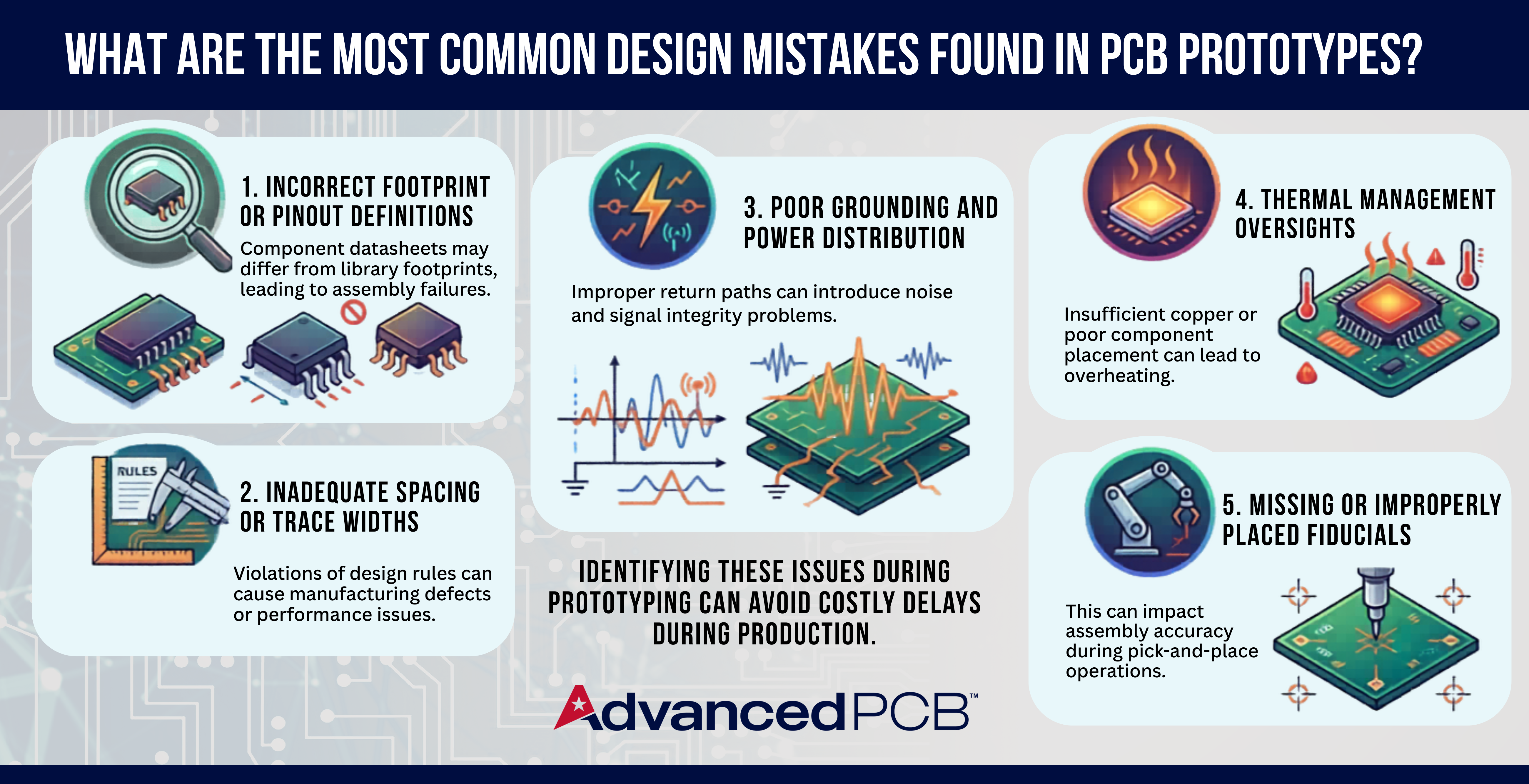
For a deeper breakdown of these types of issues, this article on common PCB design mistakes expands on where they originate and how to prevent them earlier in the design cycle.
What to Pay Attention to During a Prototype Build
A prototype should be treated as a structured validation step.
Electrical Performance
Look beyond basic functionality. Evaluate signal integrity, timing margins, and noise behavior, especially for high-speed or mixed-signal designs.
Thermal Performance
Monitor temperatures under load. Small issues here often scale into reliability problems later.
Mechanical Fit
Verify alignment with enclosures, connectors, and mounting features. Even minor offsets can create integration challenges.
Assembly Quality
Inspect solder joints, component placement, and any signs of process sensitivity. These often point to layout improvements.
If you are evaluating different build approaches, this overview of rapid PCB prototyping benefits provides helpful context on how faster iterations support better validation.
The Role of Manufacturing Feedback
One of the most valuable parts of prototyping is the feedback loop between design and manufacturing.
A DFM (Design for Manufacturability) review helps identify risks before fabrication begins. This can include trace spacing, via structures, stackup decisions, and other factors that affect yield and performance.
Catching these early allows engineers to make adjustments while changes are still manageable.
Why Speed Changes How Teams Design
Fast prototype turnaround is not just about saving time. It changes how teams approach development.
When builds take weeks, teams tend to limit iterations. When builds come back in days, engineers can test, adjust, and refine much more quickly.
This leads to:
- Better design decisions
- More thorough validation
- Fewer surprises during production
The goal is not just speed. It is learning faster.
Knowing When a Design Is Ready
There is no perfect moment when a design is “done,” but there is a point where risk is understood and controlled.
Before moving to production, teams should feel confident in:
- Electrical performance across operating conditions
- Thermal stability over time
- Mechanical integration within the system
- Consistency of the manufacturing process
When those areas are validated, the transition becomes far more predictable.
Prototyping is where the most important learning happens in PCB development.
The designs that move smoothly into production are usually the ones where the prototype phase was used intentionally to uncover issues, validate assumptions, and refine the design. Taking the time to do that well almost always saves time later.