PCB Thermal Management
How to Reduce Heat and Improve Long-Term Reliability
PCB thermal management directly affects product reliability, electrical performance, and operational lifespan. As power densities increase in AI infrastructure, aerospace electronics, industrial controls, medical devices, and automotive systems, engineers must design printed circuit boards that can efficiently move heat away from critical components before thermal issues lead to failure.
This guide from the AdvancedPCB engineering team explains how heat is generated in printed circuit boards, how it moves through PCB materials, and what engineers can do to reduce operating temperatures. We’ll cover thermal vias, copper strategies, material selection, layout optimization, simulation tools, manufacturing considerations, and relevant IPC standards that influence thermal reliability.
For engineers building high-power or thermally constrained electronics, these strategies can help prevent costly redesigns later in development.
Related resources:
How Heat Impacts PCB Performance
Heat is generated in nearly every electronic system, but it becomes far more problematic as component density increases and enclosures become smaller. Common heat sources include semiconductor switching losses, inefficient voltage regulators, resistive losses in copper traces, magnetic losses in transformers, and heat generated by LEDs or high-current power devices.
As temperatures rise, electrical performance often begins to degrade. Copper resistance increases, capacitor lifespan declines, oscillator stability can shift, and solder joints become more vulnerable to fatigue during repeated thermal cycling. In extreme cases, excessive heat can trigger thermal shutdowns or permanent component failure.
One common misconception is that thermal problems are solved primarily through advanced laminate materials. While specialty materials can help in certain environments, copper typically does far more of the thermal work. Standard FR-4 offers thermal conductivity of roughly 0.3 W/m·K, while copper conducts heat at approximately 400 W/m·K.
Key Thermal Management Techniques
The most effective techniques lower temperatures by improving conduction into the PCB stackup and enhancing dissipation to the environment. These techniques reflect proven thermal management recommendations for PCBs.
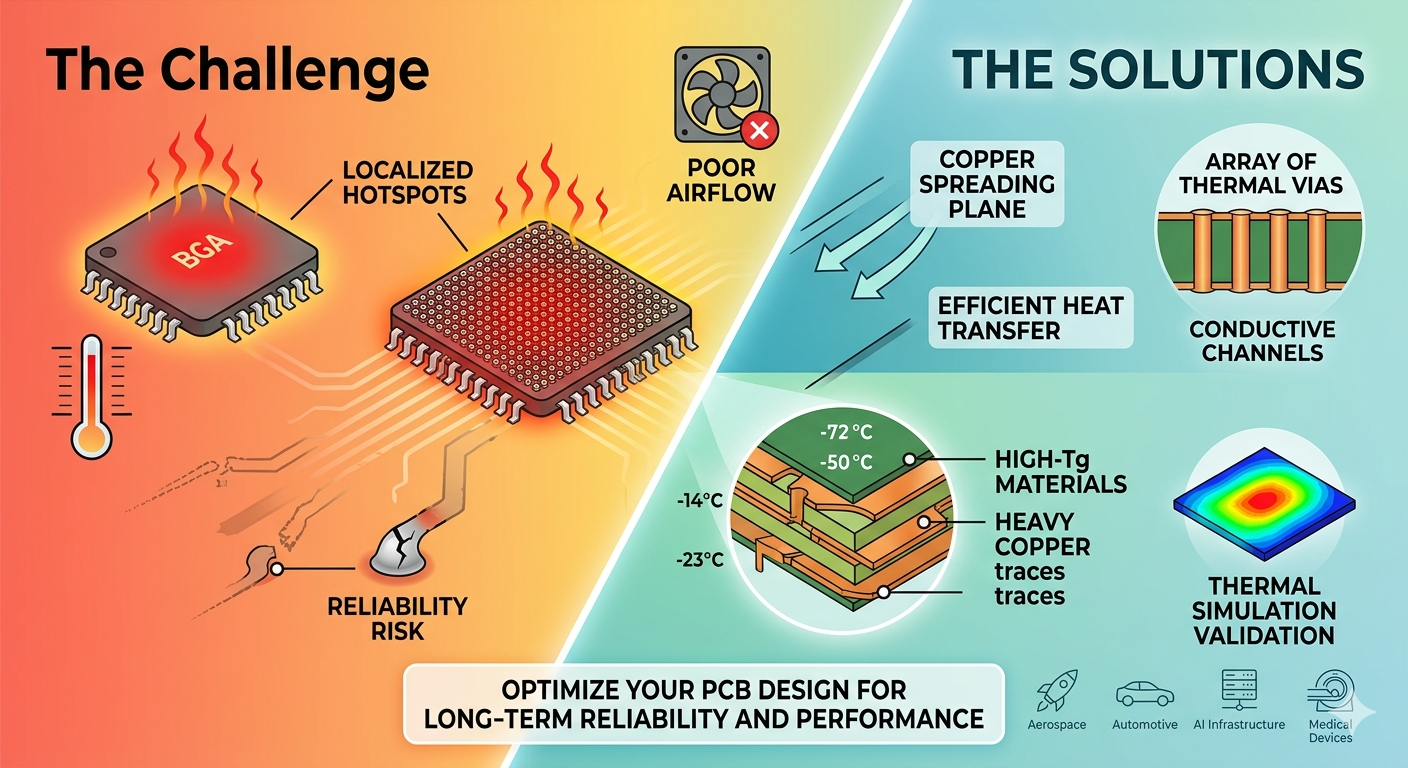
- Thermal vias: Use arrays of plated-through vias beneath hot packages such as DPAK, QFN, and power modules to move heat from the component side into internal planes and the opposite side of the board. Favor many small vias (0.2–0.35 mm finished) on 1–1.2 mm pitch to increase copper fraction and fit beneath thermal pads. Tenting or filling may be required to prevent solder wicking. Tie via arrays to large copper pours connected to ground or dedicated thermal planes to spread heat efficiently. When balancing solderability and spreading, apply PCB thermal relief patterns on pads that need controlled heat during assembly while maintaining solid thermal paths elsewhere.
- Material selection: Standard FR-4 has low thermal conductivity (~0.3 W/m·K). Enhanced resin systems and filled prepregs provide incremental improvements, while metal-core PCBs (MCPCBs) offer superior conduction for LEDs and high-power circuits. Regardless of dielectric choice, leverage copper (≈400 W/m·K) as the primary heat spreader via planes and pours. For higher ambient environments, select Tg and Td ratings that meet the thermal envelope and consider low-CTE materials to reduce mechanical stress and warpage. Choosing materials for thermal management with higher thermal conductivity PCB performance can reduce temperature rise through thickness.
- Copper thickness and trace width: Thicker copper reduces resistive losses and improves heat spreading. One-ounce copper is common; two- and three-ounce copper are beneficial for high-current rails and power distribution. Increase trace width and plane area to limit I2R losses; where space is constrained, add parallel traces or dedicated pours. Use continuous solid planes under hot devices and avoid narrow neck-downs that impede heat flow. Maintain strategic PCB thermal relief only where assembly requires it to avoid unintended thermal bottlenecks.
PCB Layout Often Determines Thermal Success
Even with the right materials, poor layout decisions can create thermal bottlenecks.
Placing multiple heat-generating components too close together often creates localized hotspots that are difficult to cool. Sensitive components such as sensors, RF devices, and analog circuitry should be physically separated from high-power devices whenever possible.
Board edges can also be valuable thermal assets. Positioning heat-generating components near airflow paths, chassis mounts, or heat sinks often improves cooling performance without increasing board size.
Copper plane design matters as well. Narrow trace bottlenecks, isolated copper islands, and poor via connectivity can restrict heat flow. Larger continuous copper pours typically provide much better heat dissipation.
For systems using forced air cooling, airflow direction should also be considered early in the design process. Poor airflow planning frequently creates recirculating hot zones that reduce cooling efficiency.
Material Selection and Stackup Planning
Material selection becomes increasingly important in high-temperature applications.
Standard FR-4 remains the most common choice because it is cost-effective and widely available. However, high-Tg materials may be better suited for applications with elevated operating temperatures. Low-CTE materials can improve reliability in aerospace and defense applications that experience frequent thermal cycling.
Metal-core PCBs are commonly used in LED systems and other high-power designs where direct heat transfer is critical.
That said, many engineers overestimate the thermal advantages of exotic materials. In many cases, improving copper distribution, stackup architecture, and via design delivers better thermal performance at a lower cost.
Thermal Analysis and Simulation Tools
Thermal analysis verifies temperature targets before fabrication, reducing re-spins and quantifying the effect of layout, stackup, and material choices. Modern PCB thermal simulation enables fast iteration on alternatives and quantifies the impact of materials for thermal management.
- Simulation software: Tools such as SimScale, Ansys Icepak, Siemens Simcenter Flotherm, and Cadence Celsius import ECAD data and use CFD to model conduction, convection, and radiation. Many CAD environments also provide stackup-aware heat maps and steady-state solvers for rapid iteration. Incorporating PCB thermal simulation early helps optimize PCB thermal conductivity pathways before hardware is built.
- Analysis workflow: Start with a power budget and simple resistance-network estimates to flag probable hotspots. Import the board with the correct layer stack, copper weights, and component power dissipation. Evaluate steady-state and transient behavior across ambient ranges and airflow conditions. Run sensitivity studies on copper area, via density, and heat sink choices to identify high-leverage changes. Correlate models with prototype data using thermocouples or IR imaging to calibrate boundary conditions. Revisit material assumptions to confirm the effective thermal conductivity PCB values match vendor specifications.
- Example outcomes: On an LED driver board, adding a via array and doubling plane area beneath the IC reduced junction temperature by approximately 12°C at the same ambient. In a sealed IoT gateway, moving a DC/DC module 10 mm toward a vent slot and increasing copper from 1 oz to 2 oz decreased regulator case temperature by about 8°C without enlarging the enclosure. These improvements were identified in simulation and confirmed in hardware, avoiding mechanical redesign. PCB thermal simulation also highlighted the benefit of switching to a more thermally conductive PCB stackup to improve through-thickness heat flow.
Manufacturing Constraints That Affect Thermal Performance
Thermal designs sometimes fail because they were optimized in CAD software but not for manufacturability.
Dense via fields can create resin starvation issues. Heavy copper designs may increase etching complexity. Copper imbalance can introduce warpage during lamination. Improper thermal pad design may also lead to solder voiding during assembly.
These challenges are easier to solve when engineering teams involve their PCB manufacturer early in development.
AdvancedPCB regularly works with engineers to optimize stackups, copper weights, via structures, and thermal manufacturability before designs move into production.
IPC Standards That Influence Thermal Design
Several industry standards directly affect thermal reliability.
- IPC IPC-2221 establishes general PCB design requirements, including conductor sizing and spacing.
- IPC IPC-2152 provides more accurate guidance for trace current capacity based on real-world thermal behavior.
- IPC IPC-6012 helps ensure rigid PCB reliability in high-temperature environments.
- IPC IPC-6013 becomes important when flex or rigid-flex designs are exposed to thermal stress.
- IPC IPC-TM-650 provides testing methodologies used to validate thermal durability.
Thermal Challenges Across Key Industries
Thermal management challenges vary widely depending on the application.
AI servers and networking systems often struggle with concentrated heat from processors and power delivery systems.
Aerospace and defense electronics frequently operate in sealed environments where thermal cycling can be severe.
Medical devices must balance compact designs with strict temperature controls.
Industrial systems often require heavy copper designs to manage motor controls and high-current applications.
AdvancedPCB supports thermal-critical designs across each of these industries through both prototype and production manufacturing.
Design Checklist for Lower PCB Temperatures
- Quantify power dissipation per component; set junction and case temperature limits; create a thermal budget that accounts for PCB thermal conductivity and interface resistances.
- Place high-dissipation parts near edges or chassis coupling points; separate from thermal sensors and precision analog; use the board as a PCB heatsink where external heat sinks are impractical.
- Provide exposed thermal pads with soldered copper pours and dense via fields; tent or fill vias as required; balance solderability with spreading using appropriate PCB thermal relief.
- Use continuous planes under hot devices and avoid thermal bottlenecks; widen traces or add parallel paths to improve the thermal conductivity PCB network.
- Select copper weight to meet current and thermal needs; evaluate 2 oz for power distribution; choose materials for thermal management that support the operating environment.
- Align heat sink fins with airflow; maintain spacing for convection; avoid recirculating warm zones; validate placement of any heat sink on PCB with airflow testing.
- Model steady-state and transient temperatures with PCB thermal simulation; run sensitivity studies on via count, copper area, and heat sink choice.
- Instrument prototypes; validate with worst-case tests; correlate models to measurements; refine assumptions about thermal conductivity of PCB layers and TIMs.
- Implement firmware-based thermal protections and telemetry; plan for maintenance where fans or TIMs are used; monitor long-term performance to confirm thermally conductive PCB paths remain effective.
Consultation and Expert Support
Complex power profiles and tight mechanical envelopes benefit from early collaboration with thermal specialists and experienced PCB manufacturers. Expert input on stackups, copper weights, via strategies, and the selection of materials for thermal management reduces risk and shortens development cycles.
- How to engage: Share power maps, placement files, stackup details, and enclosure constraints, including airflow assumptions and planned heat sinks or chassis interfaces. Early reviews surface thermal bottlenecks when changes are least costly and guide targeted thermal management recommendations for PCBs.
- Benefits: Access to calibrated models, proven PCB features such as filled vias and specific prepregs, and rapid what-if analysis helps reach compliance without overdesign. Guided PCB thermal simulation can de-risk high-power layouts before prototypes.
- Resources at AdvancedPCB: Explore design guides, stackup libraries, and application notes on thermal vias, copper weight selection, PCB thermal relief, and MCPCB options. Contact our engineering team for a thermal DFM review or to discuss material choices aligned with your performance targets, including strategies to maximise PCB thermal conductivity and practical heat sink on PCB implementations.
By addressing heat dissipation early through better layout decisions, material selection, simulation, and manufacturing collaboration, engineering teams can improve reliability while reducing costly redesigns.
If you're designing high-power electronics, AdvancedPCB can help evaluate thermal requirements before production begins.
Related Posts
Why Do PCBs Have an Even Number of Layers?
Heavy Copper PCBs for Automotive Electronics: Design Considerations