RF Microwave PCB Design: Materials, Layout, and Manufacturing Best Practices
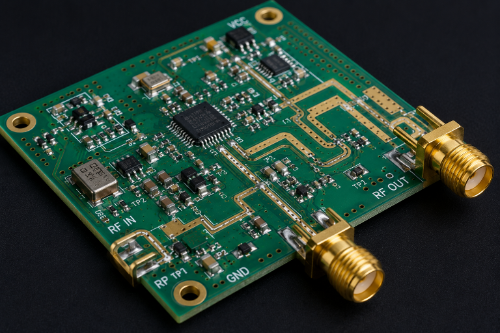
RF and microwave PCB design is becoming more important as wireless systems continue expanding across AI infrastructure, automotive radar, aerospace, satellite communications, Wi-Fi, 5G, and IoT devices. As frequencies increase, PCB traces no longer behave like simple wires. Every trace, via, connector, and material becomes part of the electrical system.
This guide from the AdvancedPCB team explains the fundamentals of RF and microwave PCB design, including material selection, transmission line behavior, stackup planning, layout strategies, manufacturing considerations, and testing methods. If you are designing RF circuits or high-frequency PCBs, this article covers the practical engineering and fabrication principles needed to improve signal integrity, reduce loss, and achieve repeatable performance.
What Is RF and Microwave PCB Design?
RF and microwave PCB design focuses on circuits that operate at high frequencies where transmission line effects, impedance control, and electromagnetic behavior become critical.
Traditional low-frequency PCB design treats traces mostly as electrical connections. In RF and microwave systems, traces behave as controlled transmission lines that must maintain consistent impedance and minimize reflections and loss.
Many modern applications operate across frequencies such as:
- 915 MHz
- 2.4 GHz
- 5 GHz
- 24 GHz
- 28 GHz
- 39 GHz
- 77–81 GHz
These frequencies are commonly used in wireless networking, radar, satellite communications, automotive sensing, and mmWave systems.
Why Are PCB Materials So Important in RF Designs?
PCB materials directly affect signal loss, impedance stability, thermal performance, and manufacturability.
Two of the most important material properties are:
Dielectric Constant (Dk)
Dk affects signal propagation speed and impedance. Stable Dk helps maintain predictable RF performance across frequency and temperature changes.
Loss Tangent (Df)
Df measures how much signal energy is lost as heat. Lower Df materials reduce insertion loss and improve signal integrity at higher frequencies.
Standard FR-4 works for some lower-frequency RF applications, but higher-frequency systems often require:
- Low-loss FR-4 blends
- Hydrocarbon ceramic laminates
- PTFE-based materials
These materials provide lower insertion loss and more stable RF performance.
What Transmission Line Structures Are Used in RF PCBs?
RF PCB layouts rely on controlled-impedance transmission lines.
Microstrip
Microstrip routes signals on an outer layer above a reference plane. It is simple to route and probe but is more exposed to environmental effects and impedance variation.
Grounded Coplanar Waveguide (GCPW)
GCPW adds grounded copper next to the signal trace to improve field containment, isolation, and launch performance.
Stripline
Stripline places the signal trace between reference planes inside the PCB stackup. This provides strong shielding and lower crosstalk but requires tighter fabrication control.
The best structure depends on frequency, routing density, isolation requirements, and manufacturability.
What Layout Practices Improve RF Performance?
RF PCB layout has a major impact on system performance.
Key best practices include:
- Maintaining continuous ground planes
- Keeping RF traces short and direct
- Avoiding large return current disruptions
- Using via fences around sensitive RF structures
- Carefully designing connector launches
- Separating noisy digital circuits from sensitive RF sections
At higher frequencies, even small layout discontinuities can affect insertion loss, return loss, and radiation performance.
How Do Vias Affect RF PCB Performance?
Vias introduce inductance and discontinuities that can degrade RF performance if not carefully controlled.
Common strategies include:
- Backdrilling unused via stubs
- Using blind or buried vias
- Adding stitching vias near layer transitions
- Minimizing unnecessary layer changes
At microwave frequencies, via transitions should often be modeled using electromagnetic simulation tools.
Many modern applications operate
How Are RF and Microwave PCBs Tested?
Testing validates that the PCB performs as expected at operating frequency.
Common RF test equipment includes:
- Vector Network Analyzers (VNAs)
- Spectrum analyzers
- Time-domain reflectometry (TDR)
Engineers use these tools to measure:
- Return loss
- Insertion loss
- Impedance discontinuities
- Harmonics and spurious emissions
- Group delay and phase behavior
Proper calibration and fixture design are critical for accurate measurement results.
Which IPC Standards Apply to RF PCB Design?
Several IPC standards are commonly referenced in RF and microwave PCB manufacturing:
- IPC-2221
- IPC-2226
- IPC-6012
- IPC-6018
- IPC-TM-650
These standards help define design requirements, material performance, fabrication quality, and testing methods for RF and microwave PCBs.
Why Manufacturing Matters More at Microwave Frequencies
At microwave frequencies, fabrication tolerances directly affect electrical performance.
Factors such as:
- Copper thickness
- Trace width variation
- Dielectric thickness
- Copper roughness
- Etch compensation
all influence impedance and insertion loss.
This is why RF PCB fabrication requires close collaboration between design and manufacturing teams. Controlled impedance planning, stackup verification, and DFM review should happen early in the project.
Successful RF and microwave PCB design requires a combination of strong electrical engineering, controlled PCB layout, material selection, and disciplined manufacturing.
The most reliable RF PCB programs:
- Start with clear electrical requirements
- Select materials based on loss and stability
- Use controlled-impedance layouts
- Validate performance through measurement
- Align design and fabrication early
As wireless systems continue moving into higher frequencies and tighter tolerances, early collaboration between engineering and manufacturing becomes increasingly important for achieving predictable RF performance.
across frequencies such as:
- 915 MHz
- 2.4 GHz
- 5 GHz
- 24 GHz
- 28 GHz
- 39 GHz
- 77–81 GHz
These frequencies are commonly used in wireless networking, radar, satellite communications, automotive sensing, and mmWave systems.
Related Posts

7 PCB Design Priorities for Surgical Robotics
.jpg?resizemode=force&maxsidesize=1226 "Large-Scale PCB Production")
Large Scale PCB Production