


Understanding Lamination Voids in PCB Manufacturing
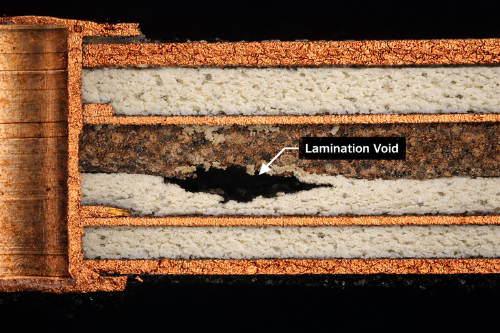
Lamination voids are a significant reliability risk in multilayer printed circuit boards. These small gaps, which are often air pockets or resin-starved regions formed during the press cycle, can degrade electrical performance, weaken mechanical bonds, and shorten product life. IPC standards and industry guidance emphasize that lamination integrity is foundational to long-term reliability, particularly for high-reliability, HDI, and thermal-cycling-intensive applications. This guide defines lamination voids, explains why they occur, outlines practical prevention strategies, and highlights the controls AdvancedPCB applies to minimize lamination defects at scale.
What Are Lamination Voids?
Lamination voids are areas of incomplete bonding between layers in a PCB lamination stackup, most commonly at interfaces between copper foils and prepreg or between core layers. They form when the bonding resin does not fully wet and fill micro-roughened copper and glass surfaces during heat and pressure, leaving small, unfilled zones that can initiate circuit board delamination or PCB delamination.
IPC-2221 identifies adequate resin wetting and complete interlayer bonding as fundamental requirements for printed board integrity. It is commonly understood that void formation is often less about peak pressure and more about resin flow timing, volatility control, and proper degassing before gelation.
Impacts of lamination voids include weaker copper-to-resin adhesion, increased risk of micro-cracking during thermal cycling, reduced peel strength, and elevated susceptibility to conductive anodic filament (CAF) growth, as addressed in IPC-6012 and IPC-4101. Severe lamination defects may lead to layer separation, opens in plated structures, and early-life or latent failures.
Common indicators include:
-
Blisters or edge lifting visible after reflow or thermal stress
-
Localized discoloration or resin-rich/resin-poor regions in microsections
-
Anomalous X-ray density around vias and unexpected impedance shifts
-
Intermittent opens during electrical test and latent PCB delamination under stress
Causes of Lamination Voids
Materials, environment, and process control all influence void formation in PCB lamination.
- Material selection: Prepreg resin content, glass style, and viscosity drive flow and wetting behavior. IPC-4101 defines acceptable resin systems and volatility limits, but stackup-specific resin balance remains critical. Low-resin or high-glass prepregs can starve interfaces, particularly adjacent to heavy copper or uneven copper distribution. Copper roughness (RA versus VLP) directly affects adhesion; very low-profile copper requires optimized resin chemistry and precise lamination control. Inappropriate release films or outdated separator materials can imprint surfaces and trap air.
- Environmental factors: Moisture absorbed in cores or prepregs expands rapidly during heating, creating steam pockets that inhibit bonding. IPC-1601 handling guidelines stress moisture control, shelf-life management, and proper storage conditions. Contamination from fingerprints, dust, or oils interferes with resin wetting and copper adhesion, increasing lamination defect risk.
- Process issues: Inadequate layup registration, insufficient vacuum, aggressive heat ramps, incorrect press pressure (too low for consolidation or too high causing resin squeeze-out), non-uniform platen temperature, and insufficient gel or cure dwell times all contribute to lamination voids. IPC-6012 performance requirements assume controlled lamination conditions capable of producing void-free bond lines. Stackups that trap air pathways or prevent effective degassing further raise the risk of PCB delamination.
Preventing Lamination Voids
Prevention requires alignment between design intent, material selection, and disciplined lamination execution.
- Design for lamination: Specify compatible core and prepreg systems with sufficient resin for the copper roughness and copper distribution. A good practice is to balance copper density across layers to avoid localized resin starvation. Validate stackups early, especially for HDI, mixed-material, or hybrid builds where resin flow behavior varies. Where appropriate, incorporate venting or resin flow features and confirm manufacturability through early DFM review.
- Controlled lamination process: Condition materials per supplier guidance and IPC-1601 recommendations include: Bake moisture-sensitive cores and prepregs as required. Use vacuum-assisted lamination to evacuate trapped air and volatiles before resin gelation. Manage heat ramps to allow gradual resin softening and flow, apply uniform pressure, and hold at cure temperature per the resin system specification defined in IPC-4101. Select clean, qualified release films and separator plates that promote resin flow rather than restrict it. For very low-profile copper, consider qualified adhesion promoters validated through peel and reliability testing.
- Quality assurance: Perform incoming material checks for resin content, volatility, moisture, and surface cleanliness. Monitor press temperature uniformity, vacuum levels, pressure profiles, and dwell times as part of a controlled process window. Verify outcomes using reliable testing procedures.
Common Question
What is an acceptable lamination void level?
The target is zero critical voids at bond interfaces. Any void that compromises mechanical integrity, electrical performance, or long-term reliability is nonconforming. Limited, non-critical micro-porosity may be acceptable only if peel strength, thermal stress, and reliability testing meet IPC-4101 and IPC-6012 requirements for the specified product class.
AdvancedPCB Controls to Mitigate Risk
AdvancedPCB integrates materials engineering, disciplined lamination techniques, and rigorous inspection to reduce lamination voids and prevent PCB delamination. By combining robust IPC-aligned process windows with early design engagement and proven lamination discipline, AdvancedPCB helps ensure strong interlayer bonds, stable electrical performance, and reliable field life across complex PCB lamination builds with minimal risk from lamination voids and related defects.