Space-Grade PCBs: Requirements, Materials, Standards, and Design Priorities
.png?resizemode=force&maxsidesize=500)
Space-grade PCBs are printed circuit boards built for satellites, launch vehicles, deep-space probes, and crewed spacecraft where long-term reliability is mandatory and repair is not possible. This guide from the AdvancedPCB explains what makes a PCB space-grade, which materials and design choices matter most, which IPC, NASA, ECSS, and ASTM standards are commonly referenced, and how space PCB technology is evolving.
If you are evaluating PCB design for space applications, the core challenge is not only surviving launch. It is building a board that can withstand vibration, vacuum, thermal cycling, contamination risks, and long mission durations while maintaining electrical and mechanical integrity. This article covers space-grade PCB materials, thermal and structural design priorities, quality standards, qualification testing, and emerging technologies shaping aerospace electronics.
What Makes a PCB Space-Grade?
A space-grade PCB is a board designed, fabricated, assembled, and documented for mission environments where failure risk must be minimized over the full service life. In practice, that means tighter process control, more extensive traceability, stricter workmanship requirements, and broader environmental validation than a commercial PCB program normally requires.
The defining characteristics usually include controlled fabrication processes, qualified material systems, low contamination levels, detailed lot traceability, and acceptance criteria aligned to aerospace or space-specific procurement requirements. For rigid boards, IPC-6012 with the Space and Military Avionics addendum is a key IPC reference; for soldered assemblies, J-STD-001JS is the current IPC space and military addendum.
Why Are Space PCB Requirements More Demanding?
Space hardware must survive a combination of launch loads and in-orbit conditions that are far more severe than most terrestrial electronics see. In a vacuum, convective cooling is effectively absent, so heat must move through conduction paths and radiative surfaces instead. Because maintenance is impractical after launch, space PCB programs emphasize defect prevention, conservative margins, stable materials, and repeatable manufacturing.
Which Design Priorities Matter Most for Space-Grade PCBs?
Thermal design is one of the first priorities. Copper planes, thermal vias, interface structures, and chassis conduction paths often do more work in space hardware than they do in ordinary electronics because heat rejection options are limited. Thermal modeling is important for determining layer count, copper distribution, via density, and component placement.
Mechanical robustness is also critical. Boards must withstand launch vibration and shock, so mounting strategy, support points, staking, bonding, and component retention methods need to be considered as part of the PCB program, not as an afterthought. NASA-STD-8739.1B is relevant here because it addresses polymeric application on electronic assemblies, including staking, bonding, encapsulation, and conformal coating.
Electrical design priorities include controlled impedance, shielding where needed, and conservative spacing for high-voltage nodes. In space applications, voltage spacing decisions should consider not only board geometry, but also contamination control, field concentration, and low-pressure discharge risk.
Which Materials Are Commonly Used in Space-Grade PCBs?
Polyimide is one of the most common materials used in space-grade PCBs because it handles heat well and can withstand repeated temperature changes without breaking down. Other materials, like low-loss laminates, are often used when signal performance is important, especially in high-frequency or RF applications. PTFE-based and ceramic-filled materials are also used in these designs because they help signals travel with less loss and more consistency.
When selecting materials for space applications, the goal is simple: the board needs to stay stable and reliable over time. That means choosing materials that can handle extreme temperatures, maintain consistent electrical performance, release very little gas in a vacuum, and hold up under vibration and thermal cycling.
Cleanliness is also a big factor. In space, even small amounts of material outgassing can create contamination that affects performance. That’s why standards like ASTM E595 are used to measure how much material may release gases in a vacuum environment.
It’s also important to clarify that making a PCB “radiation resistant” is not just about the board material. Radiation protection is mainly achieved through component selection, shielding, and overall system design. PCB materials still play an important role, but more in providing stability, durability, and cleanliness rather than being the primary solution for radiation exposure.
What Testing Is Common for Space-Grade PCB Programs?
Space-grade PCBs go through extensive testing to make sure they will perform reliably once they are launched. Since repairs are not possible in space, everything must be validated upfront.
Common tests include thermal cycling to simulate extreme temperature changes, vibration and shock testing to replicate launch conditions, and electrical testing to confirm proper performance. Additional checks like cross-section analysis and contamination testing help verify build quality and long-term reliability.
In many cases, programs also require impedance verification, material qualification, and first article inspection before production begins.
It’s important to understand that certification is not a single step. It is a full program process that can include supplier audits, qualification testing, traceability of materials, and mission-specific acceptance requirements to ensure consistency across every build.
Where Are Space-Grade PCBs Used?
Space-grade PCBs are used throughout spacecraft and satellite systems. They support critical functions such as onboard computing, communications, power distribution, navigation, and payload operation.
In smaller satellites, multiple functions are often combined onto a single board to save space and weight. In larger systems, functions are typically spread across multiple boards to improve reliability and system organization.
Whether the platform is a launch vehicle, satellite, or deep-space probe, these PCBs play a key role in keeping systems running reliably over long mission durations.
Which Emerging Technologies Are Advancing Space PCB Design?
Several technologies are helping improve performance while reducing size and weight in space-grade PCB designs.
High-density interconnect (HDI) allows for more compact layouts with shorter signal paths. Embedded passives help reduce the number of discrete components, improving reliability and saving space. Advanced thermal solutions, such as embedded metal features or improved heat spreading structures, help manage heat more effectively.
Improved simulation tools are also playing a bigger role. Engineers can now model thermal, mechanical, and electrical behavior earlier in the design process, which helps reduce risk before hardware is built.
Future improvements will likely focus on materials that offer better thermal stability, lower signal loss, and reduced outgassing, along with continued advancements in design and manufacturing techniques.
Practical Checklist for Space-Grade PCB Programs
- Start by clearly defining the mission requirements, including environment, lifespan, radiation exposure, temperature limits, and size and weight constraints.
- Select materials that can handle temperature extremes, maintain stable electrical performance, and meet outgassing requirements.
- Design the stackup to support signal integrity, heat flow, and mechanical strength as a complete system.
- Make sure the board layout aligns with how heat will be transferred, how the board will be mounted, and how components will be secured.
- Follow the appropriate standards, such as IPC-6012 or IPC-6013 for fabrication, and J-STD-001 for assembly.
- Plan for thorough testing, including thermal cycling, vibration, electrical verification, and contamination control, along with full documentation and traceability.
Takeaway
Space-grade PCBs are built around one goal: long-term reliability in an environment where failure is not an option.
That reliability comes from making the right decisions early, choosing stable materials, designing with thermal and mechanical realities in mind, and following proven standards and testing methods.
When design, materials, manufacturing, and testing are aligned from the start, teams can build PCBs that perform consistently throughout the entire mission.
Related Posts
.png?resizemode=force&maxsidesize=1226)
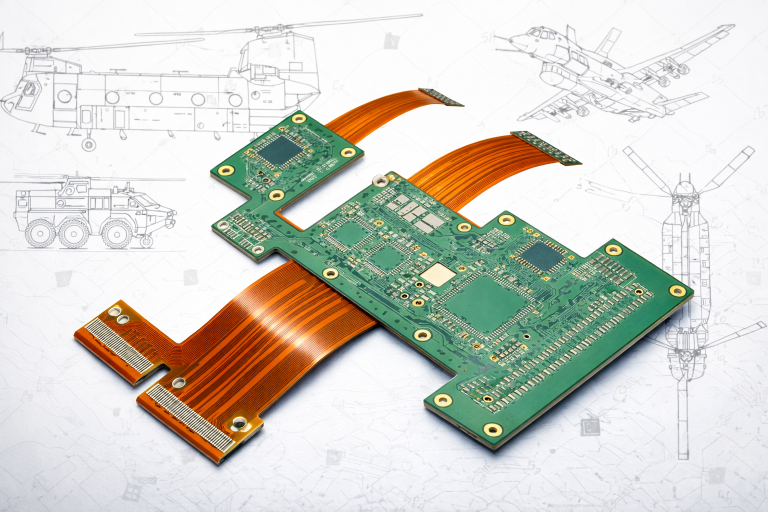
The Role of Rigid-Flex PCBs in Aerospace & Defense Prototypes

What Is MIL-PRF-31032?