


QFN Package: PCB Design, Assembly, Thermal Management, and Reliability Overview
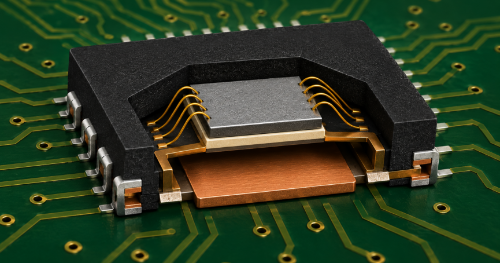
This guide explains QFN construction, thermal and electrical behavior, PCB layout recommendations, assembly considerations, and best practices for reliable manufacturing.
Why Engineers Choose QFN Packages
As electronic devices became smaller and faster, traditional leaded packages began creating limitations in board density and electrical performance.
QFN packages eliminate protruding leads and shorten the electrical path between the silicon die and the PCB. The result is lower inductance, improved signal integrity, better thermal performance, and a smaller footprint.
QFN vs QFP: What’s the Difference
| Feature | QFN (Quad Flat No-Lead) | QFP (Quad Flat Package) |
|---|---|---|
| Package Style | Bottom-terminated contacts with no protruding leads | Gull-wing leads extending from all four sides |
| Package Size | Smaller footprint for a given pin count | Larger footprint due to external leads |
| Profile Height | Low profile, typically under 1 mm | Taller package height |
| Thermal Performance | Excellent due to exposed thermal pad | Moderate thermal performance |
| Electrical Performance | Low inductance and capacitance, ideal for RF and high-speed circuits | Higher parasitic inductance due to longer leads |
| Signal Integrity | Superior for high-frequency and fast-switching applications | Good for most applications but less optimal for high-speed designs |
| PCB Routing Density | Higher density due to compact footprint | Requires more board space |
| Assembly Process | Requires precise stencil design and reflow control | Generally easier to assemble |
| Inspection Method | X-ray often required because joints are hidden | Visual inspection typically sufficient |
| Rework Difficulty | More difficult due to hidden solder joints | Easier to inspect and rework |
| Manufacturing Cost | Often lower package cost but higher inspection requirements | Slightly higher package cost but simpler inspection |
| Common Applications | RF modules, power management ICs, sensors, wireless devices, microcontrollers | Industrial controls, legacy designs, general-purpose microcontrollers |
| Reliability in Harsh Environments | Excellent when thermal pad and soldering are properly controlled | Good, but thermal performance may be more limited |
| Best Choice When | Space, thermal performance, and signal integrity are priorities | Ease of inspection, prototyping, and manual rework are priorities |
Understanding QFN Construction
A QFN package is a surface-mount integrated circuit package that uses metal terminations on the underside perimeter rather than exposed leads.
Most QFNs include an exposed thermal pad on the bottom of the package. This center pad provides a low-impedance ground connection and serves as the primary thermal path between the die and the PCB.
Internally, a QFN typically consists of:
- Semiconductor die
- Leadframe or laminate substrate
- Die attach material
- Wire bonds or flip-chip interconnects
- Mold compound
- Exposed thermal paddle
- Wire-bond QFN packages connect the die to the lead frame using fine gold or copper wires. This is the most common and cost-effective approach.
- Flip-chip QFN packages mount the die face-down using solder bumps or copper pillars. This reduces inductance and improves high-frequency performance but increases package cost and complexity.
One of the primary reasons engineers select a QFN package is its superior electrical and thermal behavior. Because QFNs eliminate long leads, parasitic inductance and capacitance are significantly reduced. These shorter current paths improve high-speed switching performance and RF signal integrity. The exposed center pad is the primary heat-transfer path between the die and the PCB. Properly connecting this pad to copper planes and thermal vias allows heat to spread efficiently through the board.
A common starting point is a thermal via array using 0.20-0.35 mm finished holes beneath the exposed pad. Filled, plugged, or tented vias can help prevent solder loss during reflow while maintaining thermal conductivity. For many power devices, the PCB effectively becomes the primary heat sink.
PCB Layout Best Practices
Proper land pattern design directly affects assembly yield and long-term reliability. Perimeter pads should follow the manufacturer's recommended land pattern while controlling solder volume to minimize bridging. The exposed thermal pad should typically use segmented solder paste apertures rather than a single opening. This reduces voiding and prevents excessive solder accumulation that can cause package floating during reflow. Additional layout recommendations include:
- Place decoupling capacitors close to power pins.
- Use solid ground planes beneath RF and high-speed devices.
- Connect exposed pads to internal planes with thermal vias.
- Maintain adequate solder mask dams between pads.
- Follow manufacturer-recommended courtyard and keep out requirements.
Successful designs balance electrical performance, thermal management, and manufacturability. QFN packages exemplify this balance but require careful PCB layout and assembly planning.
Stencil Design and Assembly Considerations
Most QFN assemblies perform well using laser-cut stainless steel stencils between 0.10 mm and 0.125 mm thick. The center thermal pad should be divided into multiple smaller paste apertures rather than using a full-pad opening. Typical paste coverage ranges from 50% to 80%, depending on package geometry and solder paste characteristics.
Convection reflow remains the standard assembly method. For lead-free SAC alloys, peak temperatures between 240°C and 250°C are common, although manufacturers should always follow solder paste supplier recommendations.
Uniform heating is critical because the exposed thermal pad contains a significant portion of the package's solder volume. Uneven heating can contribute to floating, skewing, or incomplete wetting.
Inspection and Reliability
Because most QFN solder joints are hidden beneath the package body, inspection requires more than visual examination. X-ray inspection is commonly used to evaluate:
- Thermal pad voiding
- Alignment
- Bridging
- Open connections
- Solder joint quality
IPC Standards for QFN Design and Assembly
Several IPC standards provide guidance for QFN implementation.
- IPC IPC-7351 establishes land pattern design requirements for surface-mount components, including QFN packages.
- IPC IPC-A-610 provides acceptability criteria for assembled electronic products and is widely used when evaluating QFN solder joints.
- IPC IPC-7093 provides implementation guidance for bottom-terminated components, including QFN and DFN package families.
Designing QFN Packages for Manufacturing Success
QFN packages offer an outstanding combination of size, thermal performance, and electrical efficiency. Their widespread adoption across RF, power, industrial, automotive, and embedded applications reflects their ability to support increasingly compact and capable electronic systems. At AdvancedPCB, many QFN-related assembly issues stem from thermal pad, stencil, and land pattern decisions made during PCB design. Early collaboration with your fabrication and assembly partner can help identify potential issues before prototypes are built, improving yields and reducing development cycles. By following proven PCB layout, thermal management, stencil design, and assembly practices, engineers can maximize reliability while minimizing manufacturing risk.