


Conformal Coating
Posted
7/30/2026
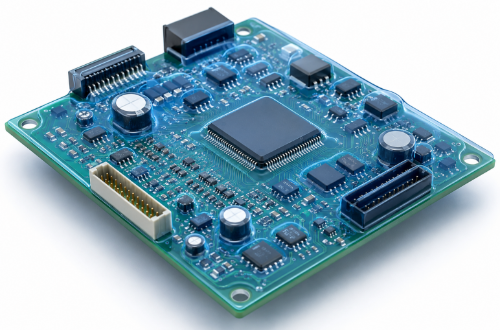
Conformal coating is a thin, protective polymer film applied to printed circuit board assemblies (PCBAs) to enhance reliability in demanding environments. By shielding components and conductors from moisture, dust, corrosive agents, and temperature extremes, conformal coatings extend product life and reduce the risk of field failures. This guide explains how conformal coating works, the leading chemistries, how to choose the right material, and proven practices for application, inspection, rework, and process control.
Conformal coating materials used in electronics are commonly qualified to IPC-CC-830, the industry specification that establishes qualification and performance requirements for electrical insulating compounds used to protect printed circuit assemblies.
Its primary purpose is to prevent environmental contaminants from reaching sensitive circuitry, reducing the likelihood of corrosion, electrical leakage, and premature component failure. When properly selected and applied, conformal coating forms an electrical insulation barrier that improves dielectric strength, reduces arcing, and helps maintain consistent electrical performance throughout the product's service life.
Coatings protect PCB assemblies through two primary mechanisms. Their dielectric properties increase surface insulation resistance and improve breakdown voltage, helping prevent electrical shorts between closely spaced conductors. Their barrier properties reduce the ingress of moisture, ionic contaminants, particulates, solvents, fuels, hydraulic fluids, and corrosive gases while providing varying levels of chemical resistance depending on the coating chemistry.
Spray and dip application methods typically produce coatings between 1 and 3 mils, while parylene chemical vapor deposition (CVD) produces highly uniform coatings between 0.2 and 2 mils with virtually pinhole-free coverage, including beneath many components.
Use conformal coating when PCB assemblies operate in humid environments, experience condensation, are exposed to corrosive atmospheres, or encounter significant thermal cycling. Properly applied coatings help mitigate copper corrosion, electrochemical migration (dendritic growth), surface leakage currents caused by ionic contamination, and reduce the likelihood of electrical shorts caused by conductive whiskers.
Selecting the right conformal coating begins with understanding the operating environment and electrical requirements.
For applications exposed to high humidity or condensation, silicone and parylene provide exceptional moisture protection. Where fuels, solvents, or harsh cleaning chemicals are present, polyurethane or epoxy coatings offer superior chemical resistance. For high-voltage circuits or fine-pitch PCB assemblies, parylene or carefully controlled acrylic coatings provide excellent dielectric performance. Flexible materials such as silicone are well suited for products that experience vibration or repeated thermal cycling.
Thermal performance should also be evaluated by reviewing the coating's operating temperature range, glass transition temperature (Tg), elongation, and long-term thermal stability. Compatibility with PCB materials including FR-4 laminates, solder mask, surface finishes, and plastics is equally important.
Engineers should also consider manufacturability. Acrylic coatings are generally the easiest to repair, while polyurethane and epoxy systems require significantly more effort to remove. Cure methods such as air drying, UV curing, and thermal curing, should be selected based on production throughput, assembly sensitivity, and manufacturing equipment. Coating thickness should be verified using calibrated application processes and representative test coupons to ensure consistent protection without excessive buildup around connectors, switches, or moving components.
Surface preparation is critical for every application method. PCB assemblies should be thoroughly cleaned before coating because residual flux, fingerprints, and ionic contamination can interfere with coating adhesion and long-term reliability. Cleaning processes should be consistent with the assembly requirements of IPC J-STD-001 and the coating manufacturer's recommendations.
Recommended inspection methods include:
Documenting coating thickness, cure parameters, lot traceability, inspection results, and environmental qualification data helps maintain process consistency and supports long-term product reliability.
bility, inspection results, and environmental qualification data helps maintain process consistency and supports long-term product reliability.
Conformal coating materials used in electronics are commonly qualified to IPC-CC-830, the industry specification that establishes qualification and performance requirements for electrical insulating compounds used to protect printed circuit assemblies.
What Is Conformal Coating?
Conformal coating is a non-conductive protective layer applied over a completed PCB assembly that conforms to the contours of components and solder joints. Most conformal coatings are applied between 1 and 3 mils (25–75 μm) thick, although thicknesses from approximately 0.5 to 5 mils (12–127 μm) are used depending on the coating chemistry and application method.Its primary purpose is to prevent environmental contaminants from reaching sensitive circuitry, reducing the likelihood of corrosion, electrical leakage, and premature component failure. When properly selected and applied, conformal coating forms an electrical insulation barrier that improves dielectric strength, reduces arcing, and helps maintain consistent electrical performance throughout the product's service life.
Coatings protect PCB assemblies through two primary mechanisms. Their dielectric properties increase surface insulation resistance and improve breakdown voltage, helping prevent electrical shorts between closely spaced conductors. Their barrier properties reduce the ingress of moisture, ionic contaminants, particulates, solvents, fuels, hydraulic fluids, and corrosive gases while providing varying levels of chemical resistance depending on the coating chemistry.
Spray and dip application methods typically produce coatings between 1 and 3 mils, while parylene chemical vapor deposition (CVD) produces highly uniform coatings between 0.2 and 2 mils with virtually pinhole-free coverage, including beneath many components.
Use conformal coating when PCB assemblies operate in humid environments, experience condensation, are exposed to corrosive atmospheres, or encounter significant thermal cycling. Properly applied coatings help mitigate copper corrosion, electrochemical migration (dendritic growth), surface leakage currents caused by ionic contamination, and reduce the likelihood of electrical shorts caused by conductive whiskers.
Why Is Conformal Coating Used on PCBs?
Conformal coating is used to protect printed circuit board assemblies from moisture, humidity, dust, chemicals, salt spray, and other environmental contaminants that can reduce electrical reliability. By creating a thin insulating barrier over the completed assembly, conformal coatings help reduce corrosion, electrochemical migration, leakage current, and dielectric breakdown in harsh operating environments. They are commonly used in aerospace, defense, medical, industrial, telecommunications, and IoT electronics where long-term reliability is critical.Types of Conformal Coatings and How to Choose
Each coating chemistry offers distinct advantages and trade-offs. The table below summarizes the most common conformal coating materials and their typical applications.| Chemistry | Key Strengths | Limitations | Typical Applications |
|---|---|---|---|
| Acrylic (AR) | Easy to apply and rework, fast air-dry, excellent dielectric performance | Moderate solvent and abrasion resistance | General-purpose electronics, prototypes, serviceable products |
| Silicon (SR) | Excellent moisture resistance, flexibility, wide operating temperature range | More difficult to rework; longer cure times | High humidity, thermal cycling, outdoor electronics |
| Polyurethan (UR) | Excellent chemical and abrasion resistance, strong moisture barrier | Difficult removal; solvent entrapment possible if applied too thick | Industrial electronics, fuels, oils, aggressive chemicals |
| Epoxy (ER) | Outstanding chemical resistance, mechanical durability, excellent adhesion | Rigid coating; most difficult to remove | Severe industrial environments, high mechanical stress |
| Parylene (XY) | Virtually pinhole-free, highly uniform coating with exceptional dielectric performance | Specialized equipment, higher cost, more complex masking and rework | Fine-pitch electronics, aerospace, medical, mission-critical assemblies |
For applications exposed to high humidity or condensation, silicone and parylene provide exceptional moisture protection. Where fuels, solvents, or harsh cleaning chemicals are present, polyurethane or epoxy coatings offer superior chemical resistance. For high-voltage circuits or fine-pitch PCB assemblies, parylene or carefully controlled acrylic coatings provide excellent dielectric performance. Flexible materials such as silicone are well suited for products that experience vibration or repeated thermal cycling.
Thermal performance should also be evaluated by reviewing the coating's operating temperature range, glass transition temperature (Tg), elongation, and long-term thermal stability. Compatibility with PCB materials including FR-4 laminates, solder mask, surface finishes, and plastics is equally important.
Engineers should also consider manufacturability. Acrylic coatings are generally the easiest to repair, while polyurethane and epoxy systems require significantly more effort to remove. Cure methods such as air drying, UV curing, and thermal curing, should be selected based on production throughput, assembly sensitivity, and manufacturing equipment. Coating thickness should be verified using calibrated application processes and representative test coupons to ensure consistent protection without excessive buildup around connectors, switches, or moving components.
Application Best Practices
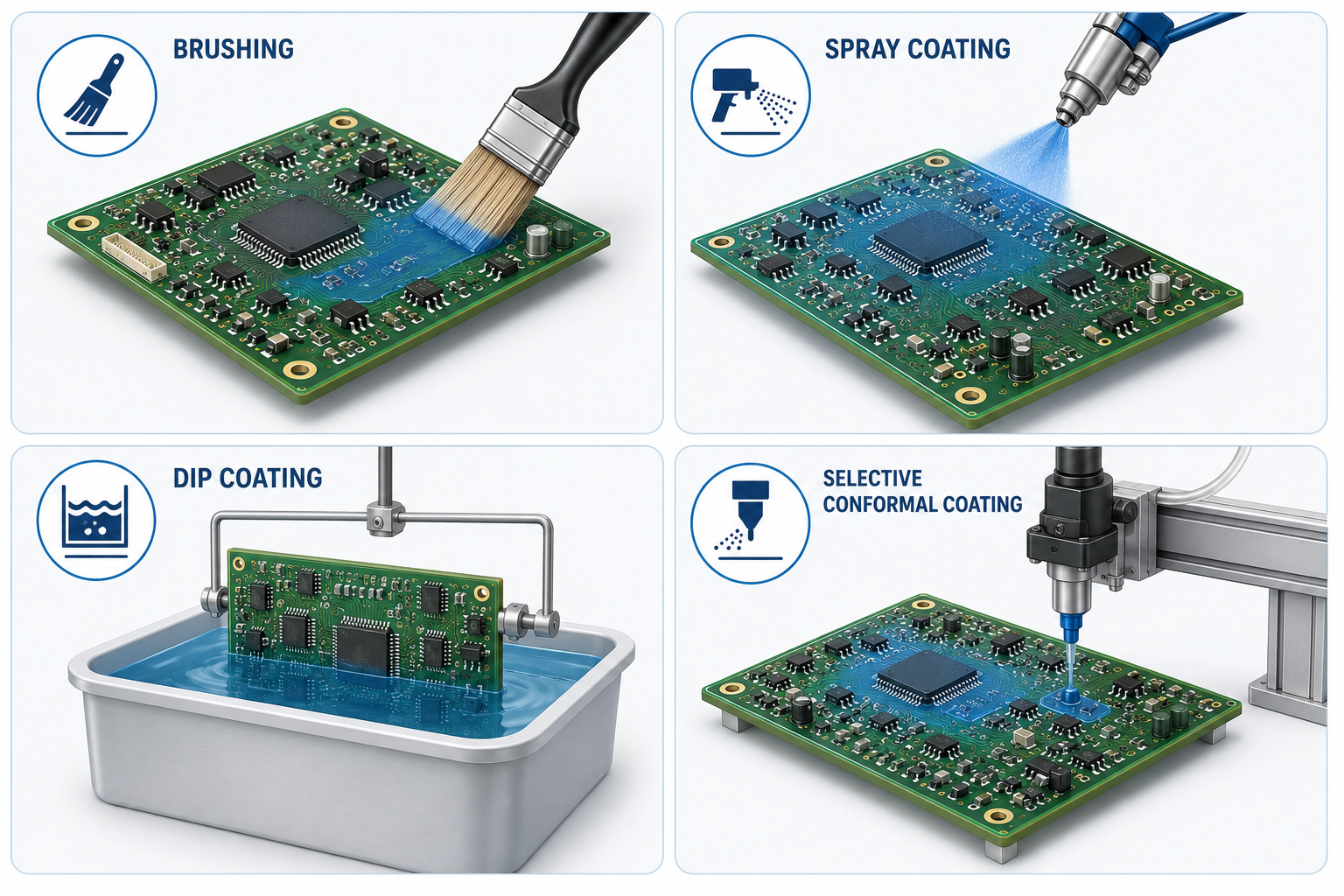
Application method directly affects coating quality, coverage, throughput, and manufacturing cost.Brushing
Best suited for prototype assemblies, engineering changes, and localized touch-up work. It offers precise control but limited repeatability.Spraying (Manual or Robotic)
One of the most common production methods. Spray coating provides excellent coverage and scalability but requires proper masking, viscosity control, spray pattern optimization, and overspray management.Dipping
Provides complete coverage for high-volume production but requires robust masking and careful process control to prevent pooling, bridging, or trapped solvents.Selective Conformal Coating
Automated selective coating systems use precision valves and programmable motion control to apply coating only where needed, reducing masking labor while improving repeatability.Surface preparation is critical for every application method. PCB assemblies should be thoroughly cleaned before coating because residual flux, fingerprints, and ionic contamination can interfere with coating adhesion and long-term reliability. Cleaning processes should be consistent with the assembly requirements of IPC J-STD-001 and the coating manufacturer's recommendations.
Inspection and Quality Control
Inspection confirms that the coating provides complete environmental protection without introducing manufacturing defects.Recommended inspection methods include:
- Visual inspection under white and UV light (for fluorescent coatings) to verify complete coverage, clean masking boundaries, and the absence of bubbles, voids, pinholes, or bridging.
- Wetting and contact angle evaluation to identify contamination or poor adhesion.
- Thickness measurement using eddy-current gauges, calibrated coupons, micrometers, or weight-gain calculations for parylene.
- Cross-hatch adhesion testing (ASTM D3359 where applicable) to verify coating adhesion.
- Environmental qualification using thermal cycling, 85°C/85% RH humidity testing, salt fog, mixed flowing gas exposure, insulation resistance testing, and dielectric withstand testing.
- Acceptance criteria for coated PCB assemblies are commonly evaluated using IPC-A-610, together with customer-specific coating requirements and workmanship standards.
Documenting coating thickness, cure parameters, lot traceability, inspection results, and environmental qualification data helps maintain process consistency and supports long-term product reliability.
bility, inspection results, and environmental qualification data helps maintain process consistency and supports long-term product reliability.
FAQs for Conformal Coating
What is the best conformal coating for a PCB?
What is the difference between conformal coating and potting?
When should a PCB use conformal coating?
What is conformal coating on a PCB?
What IPC standards apply to conformal coating?
Browse
All Categories
Recent Posts
View Recent Posts