Rigid PCB Manufacturing
Single-sided, double-sided, and multilayer rigid printed circuit boards built in the U.S. for prototype and production programs.
This page explains AdvancedPCB's rigid PCB manufacturing capabilities and helps engineers and buyers choose the right rigid board construction for a design. Below, we cover what a rigid PCB is, the three main rigid PCB types (single-layer and single-sided, double-sided, and multilayer), a side-by-side comparison, where to find our manufacturing capabilities, laminate materials and surface finishes, the industries we serve, and answers to common rigid PCB questions.
CMMC Level 2
AS9100D
IPC-6012 Class 3
ISO 9001:2015
ITAR Registered
MIL-PRF-31032
What Is a Rigid PCB?
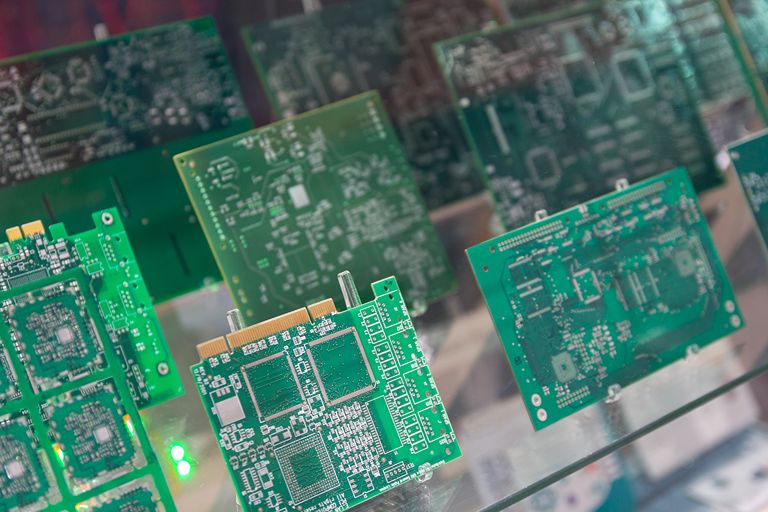
A rigid PCB is a printed circuit board built on a solid, inflexible substrate, most often FR-4 glass-reinforced epoxy laminate, that holds its shape for the life of the product. Copper conductors are etched onto one or more layers of that substrate, then protected with solder mask and identified with a silkscreen legend.
Rigid boards are the most widely used PCB construction because they offer predictable mechanical stability, straightforward assembly, and a mature material supply chain. When a design needs to bend or fold in use, flex or rigid-flex construction is the better fit. When it needs to stay flat and dimensionally stable, rigid is the default.
Types of Rigid PCBs
Rigid PCBs are grouped by how many copper layers they carry and how those layers connect. The right type depends on circuit complexity, component density, signal requirements, and budget.
Single-Sided PCBs
Double-Sided PCBs
Multilayer PCBs
Designs that require microvias, via-in-pad, or multiple sequential lamination cycles move into HDI territory. Learn more about our HDI PCBs.
Single-Sided vs Double-Sided vs Multilayer PCBS
| Single-Sided | Double-Sided | Multilayer | |
|---|---|---|---|
| Copper Layers | 1 | 2 | 3 or more |
| Layer Interconnect | None | Plated through holes | Plated through holes, blind and buried vias |
| Routing Density | Low | Moderate | High |
| Component Placement | One side | Both sides | Both sides |
| Power and Ground Planes | No | Limited | Dedicated internal planes |
| Relative Cost | Lowest | Low to moderate | Moderate to high; rises with layer count |
| Typical Applications | Power supplies, LED lighting, simple controls | Industrial controls, automotive modules, instrumentation | Aerospace and defense, medical, data center, telecom |
Rigid PCB Capabilities
Detailed specifications for rigid PCBs, including board thickness, copper weights, trace and space, drilling, and impedance tolerances, are listed on our Manufacturing Capabilities page. Capabilities can be viewed by facility.
Laminate Materials
- Standard FR-4 for multi-purpose rigid boards
- High-Tg FR-4 for lead-free assembly and elevated operating temperatures
- Halogen-free laminates
- Low-loss and high-speed laminates for signal integrity
- Rogers and PTFE materials for RF and microwave designs
- Hybrid constructions combining FR-4 and RF laminates
Surface Finishes
- ENIG (Electroless Nickel Immersion Gold)
- ENEPIG (Electroless Nickel Electroless Palladium Immersion Gold)
- HASL and lead-free HASL
- Immersion silver and tin
- OSP
- Hard gold for edge connectors
Industries We Serve
Aerospace & Defense
AI, Data Centers & High-Speed Computing
Industrial & Robotics
Medical Technologies
Telecommunications & Networks
Automotive & Advanced Mobility
Why Engineers Choose AdvancedPCB for Rigid PCBs
Six U.S. Manufacturing Facilities
AdvancedPCB operates facilities in Aurora, CO; Chandler, AZ; Santa Clara, CA; Anaheim, CA; Orange County, CA; and Maple Grove, MN. That footprint gives customers capacity, redundancy, and domestic supply for regulated programs.
Prototype to Production
Quick-turn prototypes move into volume production without changing suppliers or requalifying a new fabricator. The same engineering team supports the design from first article through recurring orders.
DFM and Stackup Engineering
Our engineers review files for manufacturability before fabrication begins. Stackup and impedance modeling is available for multilayer and controlled impedance designs.
Defense-Ready Quality
AdvancedPCB is ITAR registered and certified to AS9100D, ISO 9001:2015, and MIL-PRF-31032, with CMMC Level 2 certification. Boards are built and inspected to IPC-6012 Class 2 or Class 3.
Additional Resources
.png?resizemode=force&maxsidesize=1226)
AdvancedPCB Achieves CMMC Certification
Heavy Copper PCBs for Automotive Electronics: Design Considerations

Built for the Factory Floor

7 PCB Design Priorities for Surgical Robotics