


How PCB Drill Aspect Ratio Impacts Manufacturing
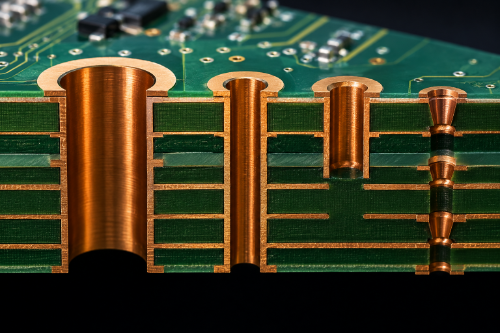
PCB drill aspect ratio is one of the most important factors affecting manufacturability and long-term reliability. It influences how effectively copper plates inside holes, impacts via reliability, and establishes practical limits for board thickness, drill sizes, and stackup construction.
Understanding aspect ratio early in the design process helps engineers avoid manufacturability issues, improve yields, and reduce the risk of plated through-hole failures in the field.
This guide explains how PCB drill aspect ratio is calculated, why it matters, common manufacturing limits, and how to design plated through-holes and HDI vias for reliable production.
Understanding PCB Drill Aspect Ratio
PCB drill aspect ratio (AR) is calculated by dividing the board thickness by the finished hole diameter.
Aspect Ratio = Board Thickness ÷ Finished Hole Diameter
For example, a 0.062-inch (1.57 mm) thick board with a 0.012-inch (0.30 mm) finished hole has an aspect ratio of approximately 5.2:1.
The same principle applies to different via structures:
- Through-hole vias: total board thickness ÷ finished hole diameter
- Blind vias: drilled depth ÷ finished hole diameter
- Buried vias: core thickness between target layers ÷ finished hole diameter
Although designers may use terms such as PCB aspect ratio, via aspect ratio, or drill aspect ratio, they all describe the same relationship between hole depth and hole diameter.
Why Aspect Ratio Matters
As aspect ratios increase, manufacturing becomes more challenging.
Deep, narrow holes are harder to clean, desmear, activate, and plate consistently. Reduced solution exchange inside the hole can result in uneven copper deposition, creating thinner copper in the center of the barrel than at the surface.
Over time, these thin areas become potential failure points during thermal cycling.
Higher aspect ratios can contribute to:
- Thin barrel copper
- Plating voids
- Barrel cracking
- Reduced thermal-cycle reliability
- Increased via resistance
- Yield loss during fabrication
In high-reliability applications such as aerospace, defense, medical, and industrial electronics, maintaining reasonable aspect ratios improves both manufacturability and long-term performance.
As PCB industry expert Happy Holden often noted, designers should focus on overall manufacturability rather than simply pushing minimum drill sizes. Reasonable aspect ratios typically improve plating consistency, process yield, and reliability more effectively than aggressive drill dimensions.
Typical PCB Drill Aspect Ratio Limits
The practical aspect ratio limit depends on board thickness, copper weight, material selection, and fabricator capability.
Typical industry guidelines include:
| Structure | Typical Aspect Ratio |
|---|---|
| Standard Through-Hole | 6:1 to 8:1 |
| Advanced Through-Hole | Up to 10:1 |
| High-Control Through-Hole | Up to 12:1 (engineering review required) |
| Laser Microvia | 0.75:1 to 1:1 |
| Stacked Microvias | Approximately 1:1 per microvia layer |
While some manufacturers can produce holes beyond 10:1, process margins become increasingly narrow. Many designers choose larger drill sizes, thinner stackups, or blind and buried vias rather than pushing through-hole aspect ratios to their limits.
Design Strategies for Managing Aspect Ratio
The most effective way to control aspect ratio is to select the largest finished hole that satisfies routing, component, and electrical requirements.
Several design practices can improve manufacturability:
- Use larger drill diameters whenever possible.
- Reduce via depth through blind and buried via structures.
- Maintain adequate annular ring dimensions.
- Account for plating thickness when specifying finished hole sizes.
- Use higher-Tg materials when thermal cycling reliability is critical.
- Balance copper distribution to minimize warpage and improve plating consistency.
For via-in-pad plated-over applications, filled and planarized structures help prevent solder wicking while maintaining reliable electrical performance.
How PCB Drill Aspect Ratio Impacts Manufacturing
Mechanical drilling remains the most common method for creating plated through-holes and typically supports aspect ratios between 6:1 and 10:1.
As hole diameters decrease and board thickness increases, drilling becomes more challenging. Tool wear, drill wander, smear, and registration tolerances all become more significant factors.
Laser drilling is commonly used for HDI microvias. Because microvias connect only one layer pair at a time, their aspect ratios are typically maintained between 0.75:1 and 1:1 to ensure reliable plating and long-term performance.
For dense HDI designs, staggered or stacked microvias allow designers to increase routing density while maintaining low aspect ratios within each individual microvia.
Plating Challenges and Reliability Considerations
Plating quality becomes increasingly important as aspect ratios rise. Deep holes restrict solution circulation and create uneven current density during electroplating. Without proper process control, this can result in thin mid-barrel copper, voids, nodules, or inconsistent copper thickness throughout the hole.
Common failure mechanisms include:
- Barrel cracks
- Corner and knee cracks
- Interconnect defects
- Thin barrel copper
- Resin recession
To combat these challenges, manufacturers use advanced desmear processes, optimized chemistry, pulse plating, reverse-pulse plating, and tightly controlled process parameters.
Quality verification typically includes coupon analysis, microsections, copper thickness measurements, thermal stress testing, and Interconnect Stress Testing (IST).
IPC Standards Related to PCB Aspect Ratio
Several industry standards provide guidance for via design, plating quality, and reliability.
- IPC IPC-2221 establishes general PCB design requirements, including conductor and via design considerations.
- IPC IPC-2226 addresses HDI structures, including microvia design and reliability recommendations.
- IPC IPC-6012 defines qualification and performance requirements for rigid printed circuit boards and plated through-hole quality.
- IPC IPC-TM-650 provides test methodologies used to evaluate plating integrity and thermal reliability.
Designers working on high-reliability products should review applicable IPC requirements early in the design process.
AdvancedPCB Design Recommendations
When evaluating drill structures, engineers should consider more than minimum drill size. The most reliable designs balance routing density with manufacturability.
At AdvancedPCB, we often recommend reducing overall board thickness, utilizing blind and buried vias, or incorporating HDI structures before pushing through-hole aspect ratios beyond standard manufacturing limits.
These approaches typically improve plating consistency, increase process yields, and reduce long-term reliability risks.
Early collaboration between the PCB designer and manufacturer can identify opportunities to optimize stackups, via structures, and drill strategies before routing constraints force more aggressive aspect ratios.
Designing for Reliable Production
PCB drill aspect ratio directly influences manufacturability, plating quality, and long-term reliability. While modern fabrication technologies continue to expand design possibilities, maintaining reasonable aspect ratios remains one of the most effective ways to improve yields and reduce risk.
By considering aspect ratio early during stackup development and working closely with your PCB manufacturer, engineers can build designs that meet performance requirements while remaining practical to manufacture at scale.
Related Posts

.jpg?resizemode=force&maxsidesize=1226 "Large-Scale PCB Production")