


FR-4: The Essential Guide to PCB Substrate Material
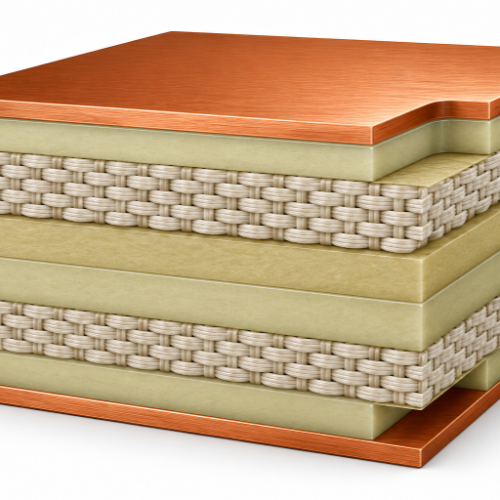
FR-4 is the most widely used PCB substrate material. Found in everything from consumer electronics and industrial controls to medical devices and aerospace systems, FR-4 offers an excellent balance of electrical performance, mechanical strength, flame resistance, and cost.
This guide explains what FR-4 is, how it performs, and when to choose standard versus high-Tg materials.
Understanding FR-4 Material
FR-4 is a glass-reinforced epoxy laminate used as the base material for most rigid printed circuit boards. It consists of woven fiberglass cloth impregnated with epoxy resin and laminated with copper foil.
The designation "FR-4" originates from a NEMA classification:
- FR = Flame Retardant
- 4 = Material performance category
Most FR-4 materials meet UL 94 V-0 flammability requirements.
One important point for PCB designers is that FR-4 is not a single material. It is a family of laminate materials with varying thermal, electrical, and mechanical properties. Common examples include Isola 370HR, Isola 185HR, Shengyi S1000, and Ventec VT-47.

Caption: FR-4 consists of woven fiberglass cloth, epoxy resin, prepreg, and copper foil laminated together to create the foundation of a printed circuit board.
Why FR-4 Became the Industry Standard
FR-4 became the dominant PCB material because it delivers reliable performance at a reasonable cost. Compared with older laminate systems, it offers:
-
Excellent mechanical strength
-
Good moisture resistance
-
Stable electrical properties
-
Reliable multilayer construction
-
Compatibility with modern assembly processes
Material selection should be driven by reliability requirements, not simply material cost. FR-4 remains the preferred choice because it meets the needs of most applications without requiring specialty laminates.
Key FR-4 Material Properties
Dielectric Constant (Dk)
The dielectric constant of FR-4 typically ranges from approximately 4.2 to 4.8 at 1 GHz, depending on resin content, glass style, and test method. This value is used when calculating:
-
Controlled impedance
-
Differential pair spacing
-
Signal propagation delay
-
Transmission line performance
Dissipation Factor (Df)
Typical values range from 0.015 to 0.025, providing acceptable loss characteristics for many designs.
Glass Transition Temperature (Tg)
Tg indicates the temperature where the resin begins transitioning from a rigid to a more flexible state.
| Material Grade | Typical Tg |
|---|---|
| Standard FR-4 | 130-140° C |
| Mid-Tg FR-4 | 150-170° C |
| High-Tg FR-4 | 170° C+ |
Coefficient of Thermal Expansion (CTE)
CTE measures how much a material expands when heated. Lower CTE values reduce stress on plated through holes and improve long-term via reliability.

Thermal Conductivity
FR-4 thermal conductivity is approximately 0.3 W/m·K, so designers typically rely on copper planes, thermal vias, and heat sinks to manage heat.
FR-4 Property Comparison
| Property | Standard FR-4 | Mid-Tg FR-4 | High-Tg FR-4 |
| Tg | 130-140°C | 150-170°C | 170°C+ |
| Dk @ 1 GHz | 4.2-4.6 | 4.2-4.6 | 4.1-4.5 |
| Df @ 1 GHz | 0.015–0.025 | 0.015–0.025 | 0.010–0.020 |
| Z-Axis CTE | Highest | Moderate | Lowest |
| Lead-Free Reliability | Good | Very Good | Excellent |
| Relative Cost | $ | $$ | $$$ |
| Typical Applications | Consumer, industrial | Automotive, multilayer | Aerospace, medical, high-reliability |
Table 1. Comparison of standard, mid-Tg, and high-Tg FR-4 materials.
Designing with FR-4
Standard FR-4 works well for most consumer, industrial, and embedded electronics.
High-Tg FR-4 is often preferred for:
-
Lead-free assembly
-
Automotive electronics
-
Aerospace systems
-
Medical devices
-
High-layer-count PCBs
-
Elevated operating temperatures
For high-speed or RF designs, engineers may use hybrid stackups that combine FR-4 with low-loss materials on critical signal layers.
IPC Standards for FR-4
Several IPC standards govern FR-4 materials and performance:
-
IPC-4101 – Laminate material requirements
-
IPC-6012 – Performance specifications for rigid PCBs
-
IPC-TM-650 – Material and reliability test methods
These standards help ensure consistent material quality and long-term reliability.
How AdvancedPCB Supports FR-4 Designs
AdvancedPCB manufactures FR-4-based boards ranging from quick-turn prototypes to complex multilayer and HDI designs.
Our engineering team assists with:
-
Stackup development
-
Controlled impedance design
-
Material selection
-
Thermal management
-
Reliability optimization
We support standard, mid-Tg, and high-Tg FR-4 materials and perform extensive inspection and testing to ensure every board meets performance and reliability requirements.
Related Posts

.jpg?resizemode=force&maxsidesize=1226 "Large-Scale PCB Production")