Electronic Components
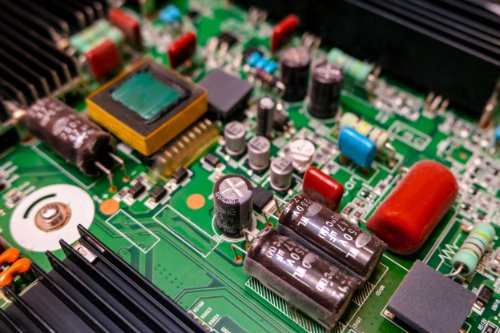
Whether you're designing a simple sensor board, an industrial controller, a medical device, or an advanced aerospace system, every printed circuit board (PCB) depends on electronic components working together to perform a specific function.
Each component plays a unique role. Some store energy, others regulate voltage, amplify signals, process data, protect circuits, or connect systems together. Choosing the right components directly affects electrical performance, product reliability, manufacturability, cost, and long-term availability.
Understanding the different types of electronic components and knowing how to select them properly helps engineers build products that perform reliably from prototype through full-scale production.
At AdvancedPCB, our engineering, fabrication, and assembly teams manufacture thousands of PCB designs every year. Through design-for-manufacturing (DFM) reviews and advanced PCB assembly capabilities, we help ensure that component selections translate into reliable, repeatable production.
What Are Electronic Components?
Electronic components are individual devices that control, store, convert, transmit, or protect electrical energy and signals within an electronic circuit. They are mounted to a printed circuit board and interconnected by copper traces to create complete electronic systems. Electronic components generally fall into three categories:
- Passive components store or dissipate electrical energy.
- Active components control, amplify, switch, or process electrical signals.
- Electromechanical components provide physical electrical connections or mechanical switching.
It's also important to distinguish between a component, a module, and an assembly.
- A component is a single electrical device, such as a resistor, capacitor, MOSFET, or microcontroller.
- A module combines multiple components into a functional circuit, such as a Bluetooth® module or DC-DC power supply.
- A PCB assembly is a fabricated printed circuit board populated with electronic components and ready for integration into the final product.

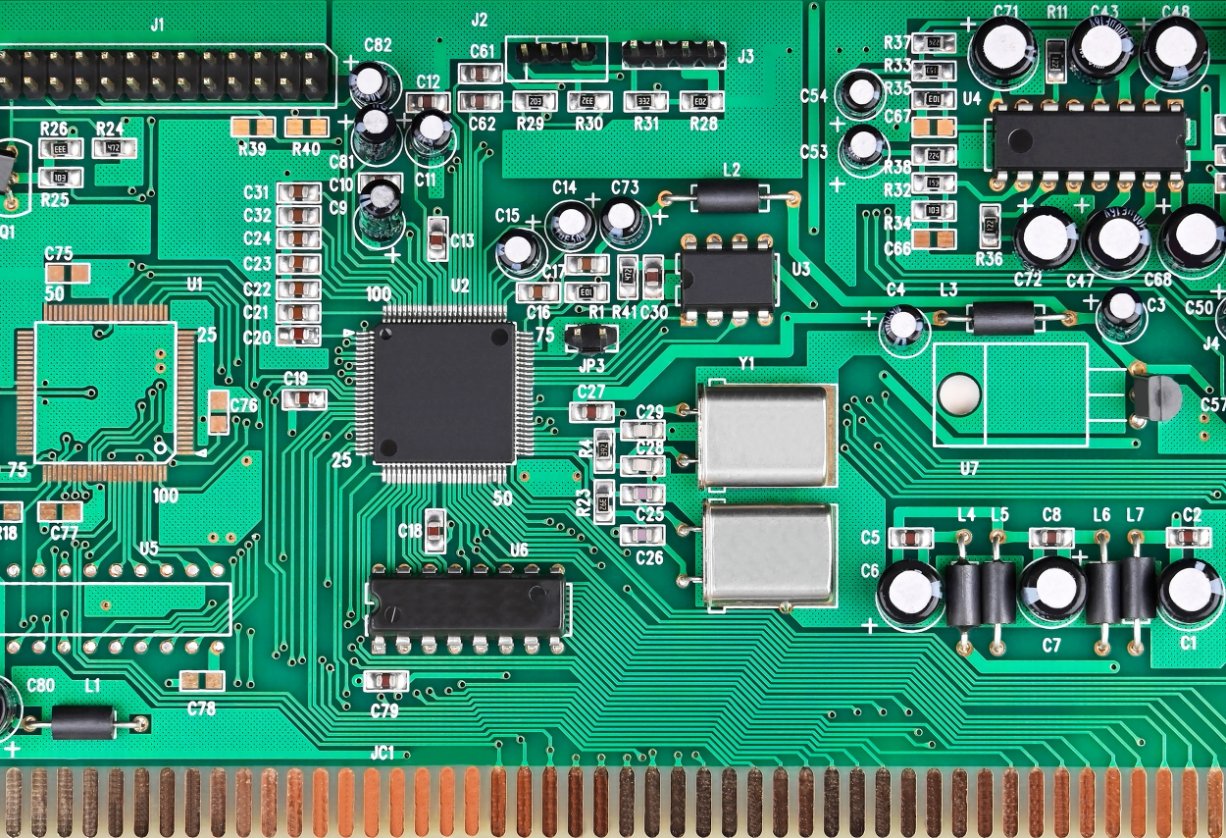
Figure 1. Modern printed circuit board populated with common electronic components including integrated circuits, resistors, capacitors, inductors, connectors, oscillators, MOSFETs, voltage regulators, and switches.
The Three Main Types of Electronic Components
-
Passive Components
Passive components do not require an external power source to perform their intended function. Instead, they store, transfer, or dissipate electrical energy.
The most common passive components include:
Resistors
Resistors limit electrical current, divide voltage, establish bias points, terminate transmission lines, and provide pull-up or pull-down functions in digital circuits.
Important specifications include:
- Resistance
- Tolerance
- Power rating
- Voltage rating
- Temperature coefficient (TCR)
Although resistors appear simple, selecting the wrong value or power rating can significantly affect circuit accuracy and long-term reliability.
Capacitors
Capacitors temporarily store electrical charge and are used throughout nearly every electronic product.
Typical applications include:
-
Power supply decoupling
-
Noise filtering
-
Signal coupling
-
Timing circuits
-
Energy storage
Common capacitor technologies include:
-
Multilayer ceramic capacitors (MLCC)
-
Tantalum capacitors
-
Aluminum electrolytic capacitors
-
Film capacitors
Engineers should evaluate capacitance, voltage rating, equivalent series resistance (ESR), ripple current capability, dielectric stability, and expected operating life.
Inductors
Inductors store energy within magnetic fields and are commonly used in:
-
Switching power supplies
-
DC-DC converters
-
EMI filters
-
RF matching networks
Important specifications include inductance, saturation current, DC resistance (DCR), self-resonant frequency, and core material.
-
Active Components
Active components require electrical power to operate and actively control electrical signals.
These devices perform switching, amplification, voltage regulation, data processing, sensing, and communications.
Diodes
Diodes allow current to flow in one direction while blocking reverse current. Common types include:
- Rectifier diodes
- Schottky diodes
- Zener diodes
- TVS (Transient Voltage Suppression) diodes
- LEDs
Applications include:
-
Reverse polarity protection
-
Voltage regulation
-
Signal clamping
-
Power rectification
-
Electrostatic discharge (ESD) protection
Transistors
Transistors function as electrically controlled switches or amplifiers. The three primary transistor families include:
- Bipolar Junction Transistors (BJTs)
- IGBTs
-
MOSFETs: MOSETSs are among the most widely used electronic components because of their efficiency in switching power supplies, battery management systems, motor controllers, and digital electronics.
Key specifications include:
-
Voltage rating
-
Current rating
-
RDS(on)
-
Gate charge
-
Switching speed
-
Thermal resistance
Integrated Circuits (ICs)
Integrated circuits combine thousands or billions of microscopic transistors into a single semiconductor package. Rather than building circuits from individual components, engineers use ICs that integrate complete functional blocks. Common IC categories include:
-
Microcontrollers (MCUs)
-
Microprocessors (MPUs)
-
Memory devices
-
Operational amplifiers
-
Power management ICs (PMICs)
-
Analog-to-digital converters (ADCs)
-
Digital-to-analog converters (DACs)
-
FPGAs
-
ASICs
-
RF transceivers
Integrated circuits have enabled the continued miniaturization and increasing performance of modern electronics.
3. Electromechanical Components
Electromechanical components provide the physical interface between electronic circuits and the outside world. Common examples include:
Connectors
Connectors transfer power and signals between PCBs, cables, and external devices. Engineers evaluate:
-
Current rating
-
Voltage rating
-
Contact resistance
-
Pitch
-
Mating cycles
-
Environmental sealing
Switches
Switches allow users or systems to open or close electrical circuits.Common types include:
-
Pushbutton
-
Toggle
-
Slide
-
Rotary
-
DIP switches
Relays
Relays use electrical signals to mechanically switch higher-voltage or higher-current circuits. They provide galvanic isolation and remain widely used in industrial equipment, automotive electronics, and power control applications.

Figure 2. Classification of electronic components into passive, active, and electromechanical categories, showing representative examples of each component family.
Surface-Mount vs. Through-Hole Components
Most modern PCB assemblies use surface-mount technology (SMT) because it enables smaller products, higher circuit density, and highly automated assembly. However, through-hole technology (THT) remains important for components requiring greater mechanical strength or higher current capacity.
| Surface Mount (SMT) | Through Hole (THT) |
|---|---|
| Mounted directly to PCB surface | Leads inserted through drilled holes |
| Smaller packages | Larger packages |
| High component density | Excellent mechanical strength |
| Automated assembly | Easier manual assembly and repair |
| Common for ICs and passives | Common for connectors and power device |
Many PCB assemblies combine both technologies to optimize electrical performance and manufacturability.
Common Electronic Component Packages
Electronic components are available in hundreds of package styles. Common packages include:
Passive Components
- 0201
- 402
- 0603
- 0805
- 1206
Leaded IC Packages
-
SOIC
-
TSSOP
-
QFP
-
DIP
Leadless Packages
-
QFN
-
DFN
-
LGA
Ball Grid Arrays
-
BGA
-
Micro BGA
-
Fine-pitch BGA
Package selection affects:
-
PCB size
-
Thermal performance
-
Signal integrity
-
Inspection requirements
- Manufacturability
- Rework capability
How to Choose the Right Electronic Components
Selecting electronic components requires balancing electrical performance, reliability, manufacturability, availability, and cost. Best practices include:
-
Define the electrical requirements, including voltage, current, frequency, power, and accuracy.
-
Select components with appropriate derating rather than operating near their maximum limits.
-
Verify the operating temperature range and environmental requirements.
-
Confirm package compatibility with the PCB layout and assembly process.
-
Evaluate component lifecycle status and long-term availability.
-
Consider approved alternate manufacturers where appropriate.
-
Prototype and validate performance before volume production.
Engineers should also consider compliance requirements such as RoHS, REACH, UL, AEC-Q100, and AEC-Q200 when applicable.
IPC Standards That Support Component Selection
Several IPC standards help engineers translate component selections into manufacturable PCB designs. These include:
-
IPC-2221: Generic standard on printed board design.
-
IPC-7351: Surface-mount land pattern design.
-
IPC-A-610: Acceptability of electronic assemblies.
-
IPC-6012: Qualification and performance requirements for rigid printed boards.
Following these standards helps improve solder joint reliability, manufacturability, inspection quality, and long-term product performance.
Bringing Component Selection into Manufacturing
Selecting the correct electronic components is only part of developing a successful electronic product. The PCB stackup, copper geometry, surface finish, solder mask, stencil design, reflow process, and inspection strategy must all support the chosen components and their packages.
At AdvancedPCB, our engineering teams review every design for manufacturability before production begins. Our DFM process evaluates component footprints, spacing, polarity, thermal requirements, assembly considerations, and potential manufacturing risks to help improve first-pass yields and long-term reliability.
Whether you're building prototypes or transitioning into production, partnering with an experienced PCB manufacturer helps ensure your component selections become reliable, manufacturable products.
Related Posts
.jpg?resizemode=force&maxsidesize=1226 "Prototype PCB Fabrication in the US")
Prototype PCB Fabrication in the USA
Choosing a PCB Assembly Manufacturer: What Engineers Should Know