


Understanding the Building Blocks of PCBs
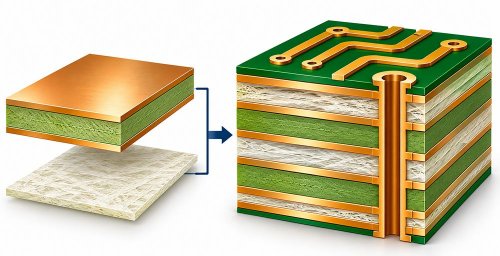
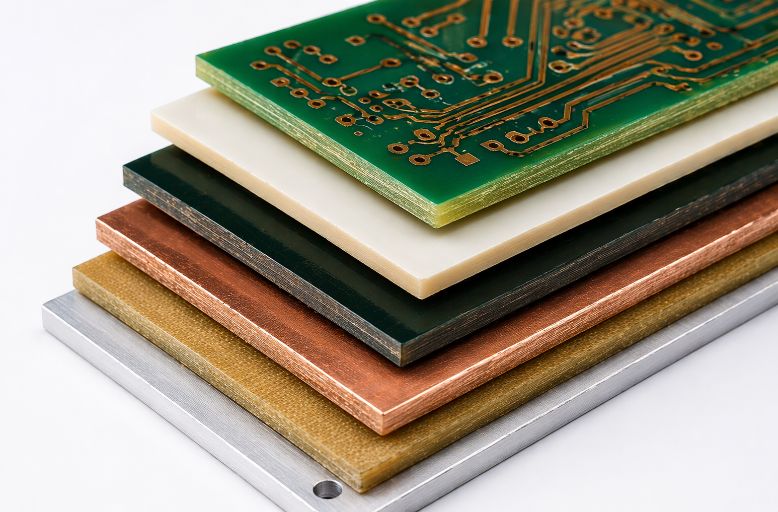
Have you ever wondered what a printed circuit board (PCB) is actually made of? Most rigid PCBs are made from fiberglass-reinforced epoxy resin, commonly called FR-4, and copper. Multilayer PCBs also use materials called cores and prepreg to build and bond the layers together. In this beginner's guide, we'll explain the basic PCB materials, what each one does, and how they come together to form a finished circuit board.
What Are the Basic Parts of a PCB?
A printed circuit board provides a physical foundation for electronic components and the electrical connections between them.
Most PCBs contain four basic material elements:
- Substrate: The insulating material that gives the board its structure and supports the circuitry.
- Copper: The conductive material used to create electrical pathways, called traces, between components.
- Solder mask: The protective coating, often green, that covers much of the outer copper and helps prevent unintended solder connections.
- Silkscreen: The printed markings used to identify components, reference numbers, and other assembly information.
Multilayer PCBs also contain internal copper layers, insulating cores, and prepreg materials that bond the layers together. Understanding these building blocks makes it easier to see how PCB materials affect electrical performance, durability, and manufacturing.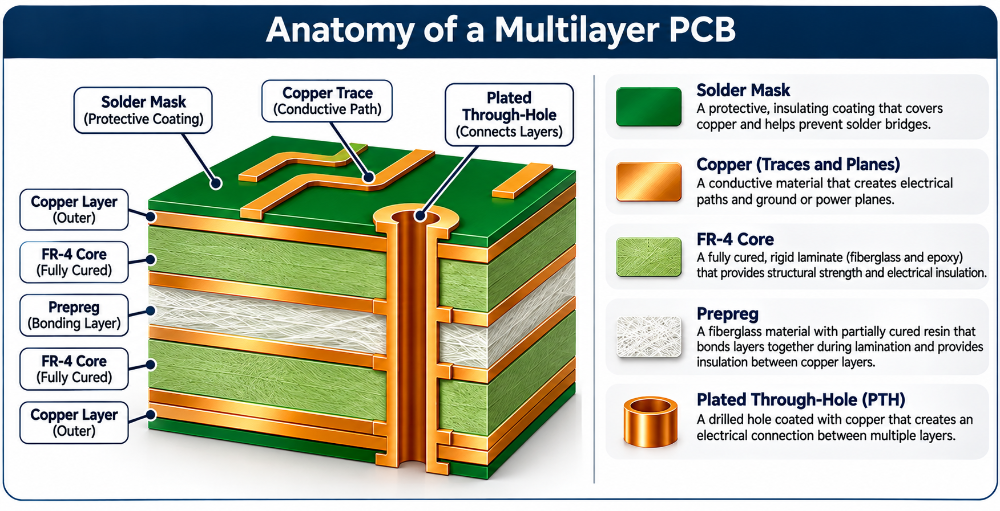
What Is a PCB Substrate?
A PCB substrate is the insulating foundation that supports the copper circuitry and electronic components on a printed circuit board.Think of the substrate as the structural base of the board. It holds the copper traces in position, provides mechanical strength, and prevents electrical connections from touching where they should remain separated. In most rigid PCBs, the substrate is made from a material called FR-4.
What Is PCB Substrate Made Of?
Most rigid PCB substrates contain two primary materials:- Fiberglass: Woven glass fibers that provide strength and help the board maintain its shape.
- Epoxy resin: An insulating material that holds the fiberglass together and helps form a rigid board.
What Is FR-4 PCB Material?
FR-4 is the most common material family used to manufacture rigid printed circuit boards. The name refers to a flame-retardant, fiberglass-reinforced epoxy laminate. FR-4 is widely used because it offers a practical combination of:- Mechanical strength
- Electrical insulation
- Thermal performance
- Manufacturing compatibility
- Cost-effectiveness
What Is Prepreg in PCB Manufacturing?
PCB prepreg is a fiberglass material impregnated with partially cured resin. It is used to bond the layers of a multilayer PCB together during manufacturing. The word prepreg is short for pre-impregnated. Prepreg may look similar to a thin sheet of fiberglass, but it contains resin that has not yet fully hardened. During PCB manufacturing, prepreg is placed between layers of the circuit board. Heat and pressure cause the resin to soften and flow around the copper features. As the resin finishes curing, it permanently bonds the layers together.Why Is PCB Prepreg Important?
Prepreg has three important jobs.- It holds the layers together. Prepreg acts as the bonding material that turns multiple PCB layers into one solid structure.
- It provides electrical insulation. Prepreg separates copper layers so electricity travels only through the intended connections.
- It helps control layer spacing. The final thickness of the prepreg affects the distance between copper layers, which can influence signal performance.
What Is a PCB Core?
A PCB core is a fully cured insulating laminate, commonly made from FR-4, with copper foil bonded to one or both sides. Unlike prepreg, the resin in a core has already hardened. The core provides a stable foundation for creating copper circuit patterns. During multilayer PCB manufacturing, copper on the core is patterned and etched to form internal electrical connections. The patterned cores are then combined with prepreg and additional copper layers to create the complete board.
What Is the Difference Between PCB Core and Prepreg?
The easiest way to understand the difference is to think about their roles during manufacturing.PCB core:
- Already fully cured and rigid
- Commonly supplied with copper foil
- Provides a stable base for circuit patterns
- Becomes part of the finished PCB structure
PCB prepreg:
- Contains partially cured resin
- Typically supplied without copper foil
- Bonds PCB layers together during lamination
- Becomes fully cured during manufacturing
Both materials provide electrical insulation, but they serve different purposes when the board is assembled.
How Are the Layers of a PCB Put Together?
A simple two-layer PCB typically consists of an insulating laminate with copper circuitry on both sides. More complex electronics often require four, six, eight, or more copper layers. These multilayer PCBs use cores, prepreg, and copper foil arranged in a specific order called a PCB stackup.Here's a simplified look at how a multilayer PCB is made.
Step 1: Create the Internal Copper Circuits
Copper-clad cores are processed to form the internal circuit patterns.Step 2: Stack the Materials
The patterned cores are arranged with prepreg sheets and additional copper foil according to the required layer structure.Step 3: Apply Heat and Pressure
The stack is placed in a lamination press. Heat and pressure cause the prepreg resin to flow and cure, bonding the materials into one solid board.Step 4: Drill and Plate the Holes
Holes are drilled through selected portions of the board. Copper plating creates electrical connections between the required layers.Step 5: Finish the Board
The outer copper circuitry is formed, solder mask and surface finish are applied, and the board is inspected and tested. The result is a finished PCB containing multiple conductive copper layers separated by insulating materials.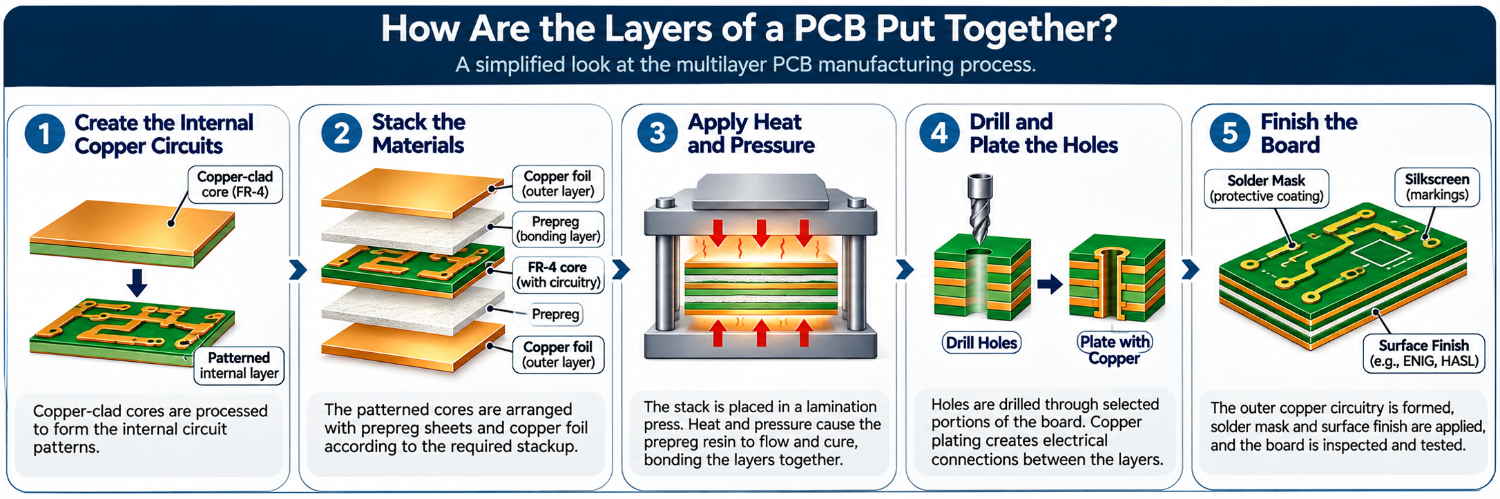
What Other PCB Substrate Materials Are Used?
Although FR-4 is the most common rigid PCB material, specialized applications may require different substrates.Polyimide for Flexible PCBs
Polyimide is a thin, flexible insulating material used in flexible and rigid-flex PCBs. It allows circuits to bend or fold, making it useful in compact electronic assemblies, medical devices, aerospace systems, and wearable technology.PTFE and Other RF Materials
PTFE-based and other specialized high-frequency laminates are used in RF and microwave PCBs. These materials can offer lower electrical losses and more controlled dielectric properties than conventional FR-4. They are commonly considered for radar, satellite communications, antennas, and other high-frequency applications.Metal-Core PCBs
Metal-core PCBs use a metal base, often aluminum, to help spread heat away from electronic components. An insulating dielectric layer separates the metal from the copper circuitry. These boards are frequently used in LED lighting and power electronics.Why Does PCB Material Selection Matter?
PCB materials affect more than the physical appearance of a circuit board. The materials selected during design can influence electrical performance, manufacturing requirements, and long-term reliability.Here are five important properties engineers consider.
- Electrical insulation: The substrate must keep conductive layers separated while supporting the intended circuit operation.
- Dielectric properties: Materials affect how electrical signals travel through the board. This becomes particularly important in high-speed and RF designs.
- Temperature resistance: PCB materials must tolerate the temperatures encountered during assembly and operation.
- Mechanical strength: The material must provide the rigidity or flexibility required by the application.
- Thermal expansion: Different materials expand and contract as temperatures change. Excessive expansion can place stress on plated holes and other board features.
Common PCB Material Mistakes Beginners Should Avoid
Understanding a few common misconceptions can help engineers make better material decisions.Mistake 1: Assuming all PCBs are made from the same material.
FR-4 is common, but flexible, high-frequency, and metal-core PCBs may use different substrates.Mistake 2: Thinking prepreg and core are interchangeable.
Both are insulating materials, but cores are fully cured while prepreg is partially cured and used for bonding.Mistake 3: Assuming more layers always mean a better PCB.
Additional layers can provide more routing space and reference planes, but the appropriate layer count depends on the design requirements.Mistake 4: Selecting materials based only on cost.
Electrical performance, operating temperature, reliability, and manufacturing compatibility are also important.Mistake 5: Finalizing the PCB stackup without manufacturer input.
Working with the manufacturer early can help confirm material availability, layer thicknesses, and fabrication requirements.PCB Materials and Manufacturing at AdvancedPCB
AdvancedPCB manufactures printed circuit boards using a range of materials for applications from quick-turn prototypes to complex multilayer production. Our capabilities include standard and high-Tg FR-4, specialized high-frequency laminates, multilayer PCBs, and flexible and rigid-flex constructions. Our engineering and manufacturing teams can help review material requirements, layer stackups, controlled impedance, and design for manufacturability considerations before fabrication.
Be open to material substitutions. Just as engineers consider alternative electronic components to address shortages or long lead times, they should also consider qualified PCB material alternatives. Different laminate manufacturers may offer materials with comparable electrical, thermal, and mechanical properties. Working with your PCB manufacturer to evaluate suitable substitutions can help reduce lead times, avoid supply chain disruptions, and keep projects on schedule. Any substitution should be reviewed and approved against the design's performance, reliability, and customer requirements before use.
Understanding PCB materials is an important first step in designing a reliable circuit board. Choosing the appropriate substrate, core, and prepreg helps ensure the finished board meets the electrical and mechanical requirements of the application.
Explore our PCB Manufacturing Capabilities to learn more about our materials and fabrication services.
AdvancedPCB
FAQs for PCB Substrates, Prepreg, and Cores
Related Posts
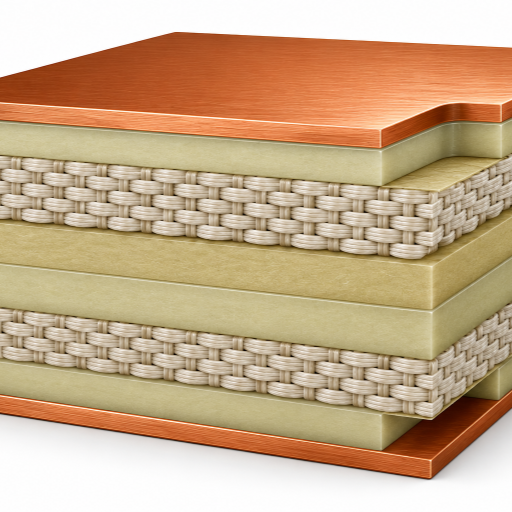
FR-4: The Essential Guide to PCB Substrate Material
PCB Material Selection: How to Choose the Right Materials in a High-Demand, Supply-Constrained Market
