PCBs for Surgical Robotics
.png)
A surgical robot translates a surgeon’s hand movements into precise instrument motion while transmitting video, position, and sensor data in real time. This work depends on circuit boards inside robotic arms, wristed instruments, endoscopic cameras, vision systems, and surgeon consoles. Each board must operate reliably within the system’s performance and safety requirements.
Below, we cover where PCBs are used in surgical robots, the PCB technologies that fit each subsystem, key design considerations, quality and traceability requirements, and how we take programs from prototype to production. It is written by the AdvancedPCB team, drawing on PCB fabrication experience dating back to 1977 across six U.S. manufacturing facilities.
6 U.S.-Based Facilities
IPC Class 3
ISO 9001:2015
ITAR Registered
Quick-turn to Volume
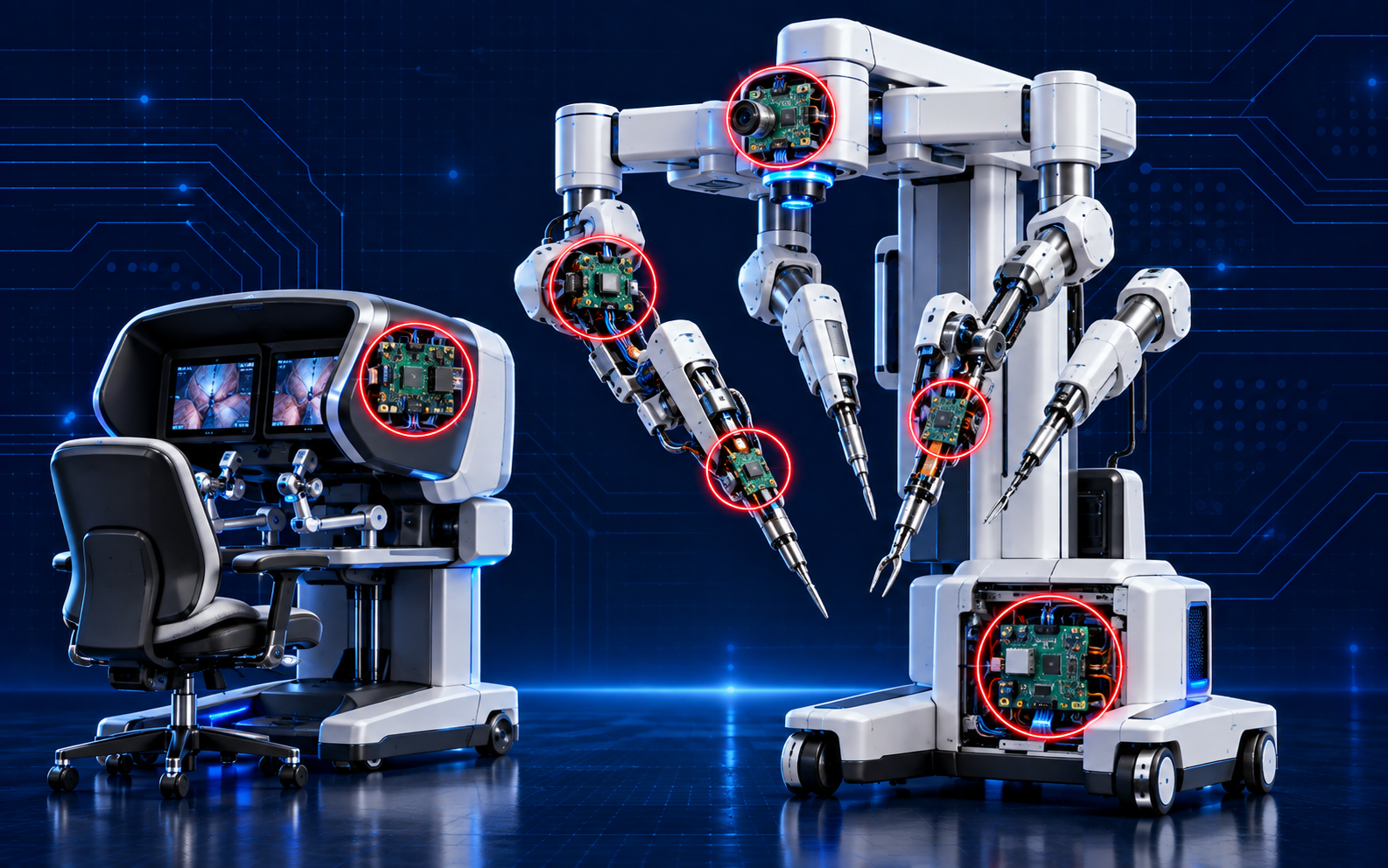
Where PCBs Live in a Surgical Robot
A surgical robot spans a patient-side cart, a vision system, and a surgeon console, and each places different demands on the PCB.
- Robotic Arms and Instrument Drives
Motor control and encoder boards at each joint position the tool with high precision. They need stable power, low-noise feedback, and reliable interconnects through moving joints. - Wristed Instruments and End Effectors
Articulating instruments carry circuitry in a shaft millimeters across. Thin flex and rigid-flex circuits route signals through the shaft and wrist where rigid boards cannot fit. - Endoscopic Vision and Imaging
3D high-definition camera heads give the surgeon a clear view of the surgical field. These boards rely on miniaturized HDI and controlled impedance for high-speed video. - Force Sensing and Haptics
Force and torque sensors measure instrument contact and feed data back to the surgeon. Low-noise layouts protect small analog signals from motor drive noise. - Surgeon Console and Compute
The console converts hand controller input into robot motion. These boards use high-layer-count stackups, fine-pitch BGA breakout, and high-speed routing. - Power, Isolation, and Safety Monitoring
Isolation and redundant monitoring circuits keep the system safe for patients and staff. Layouts must support the spacing the OEM’s safety design requires.
PCB Technologies for Surgical Robotic Systems
Rigid-Flex and Flex PCBs
Flex and rigid-flex circuits can reduce connector and cable requirements when routing signals through instrument shafts, wrists, and moving arm joints.
HDI and Microvia PCBs
Controlled Impedance
Miniaturized Multilayer PCBs
Thermal Management
IPC Class 3 High-Reliability Builds
Designing PCBs for Surgical Robotics
Surgical robotics combines the miniaturization of medical instruments with the motion control of industrial robots and the reliability expectations of safety-critical medical equipment. Designs that account for manufacturing early move faster through verification and validation. Key considerations include:
- Miniaturization: fitting sensing and control circuitry into instrument shafts and camera heads measured in millimeters
- Flex life: bend radius, copper type, and coverlay selection for circuits that articulate through wrists and arm joints
- Signal integrity and low noise: protecting video, encoder, and force-sensor signals from motor drive and power noise
- Isolation and spacing: layouts that support the OEM’s creepage, clearance, and patient isolation requirements
- Cleaning and reprocessing: materials, finishes, and coatings selected with the equipment’s cleaning, disinfection, or sterilization process in mind
- Traceability and change control: documented materials and processes so a validated design stays the same in production
AdvancedPCB engineers review stackups, flex design, and DFM with your team before release, so issues are caught before they affect your build schedule. Request a Free DFM Filecheck.
Quality, Traceability, and Certifications
In surgical robotics, board-level reliability contributes to patient safety and the dependable operation of the complete system. AdvancedPCB builds to documented, audited processes that support the quality systems of medical device OEMs:
- ISO 9001:2015
Compliance with RoHS and REACH regulations
PCB fabrication to IPC Class 2 or Class 3 acceptance criteria, as specified by the customer
Testing and inspection options include bare-board electrical testing, impedance verification, automated optical inspection, X-ray inspection for assembled boards, and ionic cleanliness testing.
Full traceability and revision control
From Prototype to Mass Production
Surgical robotics programs move through many hardware revisions during bench testing, lab evaluation, and design verification. Once a design is validated, production boards need to match it build after build.
- Quick-Turn Prototypes
Fast fabrication turns for rapid design iteration, with standard turns of 3-5 days. - Assembly and Verification Support
Prototype PCB assembly alongside fabrication reduces handoffs and gets functional hardware to your test lab sooner. - Scaled Production
Domestic production across six U.S. facilities, with global services available for mass production requirements.
Featured Articles
Engineering insights from the AdvancedPCB team on designing and building PCBs for surgical robotic systems.
7 PCB Design Priorities for Surgical Robotics
Read the article